
July 2026
Published on 9 July 2026
Hello and welcome to our newsletter
We use this newsletter to share:
- information about updates or changes to standards, guidelines, processes or requirements
- links to relevant publications and information
- upcoming training opportunities or changes to training requirements
- handy tips and tricks to support use of the Roadworks Portal
- safety information, including reminders about rules.
Help your co-workers stay up-to-date by encouraging them to also subscribe to this newsletter.
Guide to Temporary Traffic Management updates
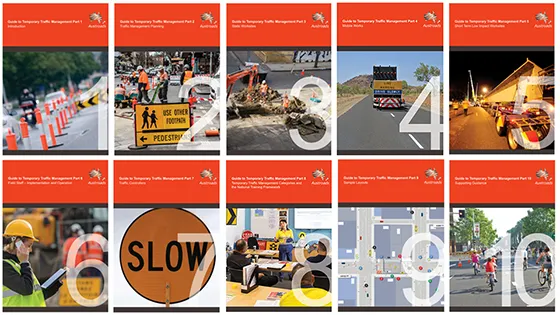
Austroads has updated nine parts of the Guide to Temporary Traffic Management (AGTTM). This guide is an important tool used to plan and manage traffic around roadwork sites across Australia.
It is used by road agencies, contractors and crews working on or near roads. The guide helps make sure traffic management is safe, efficient and consistent, and that everyone follows the rules.
These updates follow earlier changes to Part 8, which focuses on roles, training and accreditation. The rest of the guide has now been updated to match those changes. This makes the whole guide clearer and easier to use.
Patsy Thomas, National Temporary Traffic Management Operations Manager, said the guide helps everyone across Australia work in a similar way.
“These updates make it easier to apply the guide on the job, helping create safer worksites and safer roads for everyone.”
What has changed
The changes cover Parts 1 to 7, 9 and 10 of the guide and include:
- clearer requirements for traffic management plans
- better guidance for different types of worksites
- more information about supervising workers during training
- extra detail on checking and reviewing traffic management practices
- updates to layouts and examples to make them easier to use.
A supporting report is also available. This explains all the changes in detail for those who want more information.
Learn more about the updates
To help people understand the updates, Austroads will run a series of free webinars.
Anyone who registers will also get a recording after the session:
- Using and understanding the AGTTM for TMDs
Tuesday, 4 August at 1pm AEST - Using and understanding the AGTTM for RIMs
Tuesday, 1 September at 1pm AEST - Using and understanding the AGTTM for TCs and TMIs
Tuesday, 20 October at 1pm AEDT - Using and understanding the AGTTM for PMs and clients of TMSPs
Tuesday, 24 November at 1pm AEDT
The AGTTM is part of Austroads’ efforts to make roadworks safer and to improve how traffic is managed across Australia. This includes things like standard training, a national registration system, and better use of new technology.
Learn more about Austroads’ work to improve temporary traffic management.
View previous permits on the Roadworks Portal
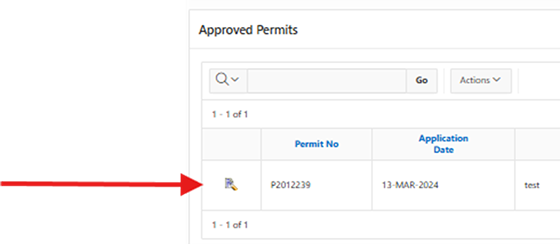
You can now view previous permits through the Roadworks Portal.
To view:
- sign in to the portal
- look under the ‘Approved Permits’ tab
- select the icon to the left of permit numbers to view previous records.
For more information, contact dit.roadworks@sa.gov.au.
Restrictions for public holidays
Some roads have restricted working hours before a long weekend because of changes to the number of vehicles on our roads. Works on these roads must finish by 12 noon on the weekday before a long weekend.
View the list of roads in South Australia that may be subject to long weekend restrictions.
Public holidays for 2026
- Labour Day – Monday, 5 October
- Christmas Day – Friday, 25 December
- Proclamation Day/Boxing Day – Saturday, 26 December and Monday, 28 December.
Visit the SafeWork SA website for the full list of public holidays.
Restrictions for Special Events
If you close a road or reduce speeds for any community events you will need a SAPOL approval notice (as set out in Section 33 of the Road Traffic Act 1961).
If you are not sure, contact the TMC on 1800 018 313 for advice.
Special Events for 2026
- Royal Adelaide Show – Saturday, 5 September to Sunday, 13 September
- City to Bay – Sunday, 20 September
- Shannon’s Adelaide Rally – Friday, 16 October to Sunday, 18 October
- Bay to Birdwood – Sunday, 18 October
- Christmas Pageant – Saturday, 14 November
- bp Adelaide Grand Final (formerly Adelaide 500) – Thursday, 26 November to Sunday, 29 November.
VMS board messaging
Any VMS messaging is to be in accordance with Operational Instruction 2.36:
- Maximum of three lines
- Maximum of two pages
- Three second interval.
Safety tip: advance warning sign placement
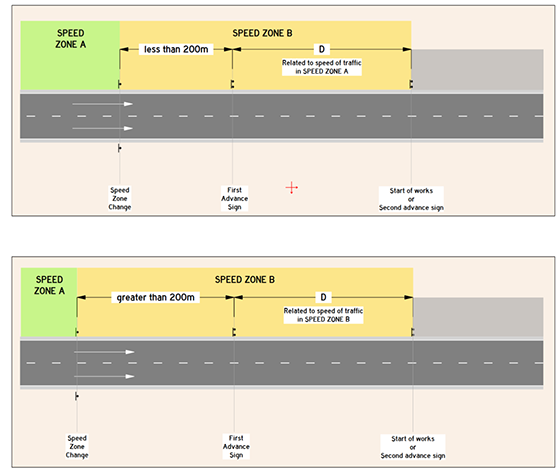
Figure: Clarification of change of speed sign placement from Section 2.5.3 and Fig 2.2 of AGTTM Part 3.
Traffic Guidance Scheme (TGS) submissions show there is confusion around the placement of change of speed advance warning signs.
The diagram above is provided to clarify the recommended spacing “D” for advance warning signs.
Recommended spacing:
- If the proposed advance warning sign location is within 200m of a change in speed zone, the position of the sign relates to the speed of traffic in zone A.
- However, if the advance warning sign placement is more than 200m of the change of speed zone, then the sign placement relates to the speed of traffic in zone B.
Example: If the speed in zone A is 60km/h, the workzone speed limit is reduced to 40km/h and the first advance warning sign placement is within 200m of the 40km/h speed sign, the next warning sign distance ‘D’ should be based on the 60km/h speed zone.
Refer to Table 6.1 in in the SA Standards for Workzone Traffic Management to determine the appropriate value of ‘D’.
Safety tip: Adjustment to existing speed limit signs
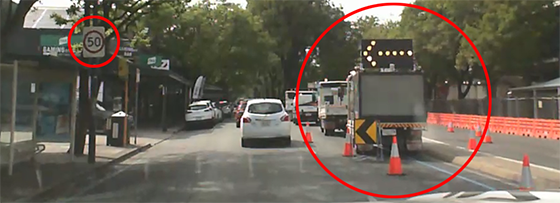
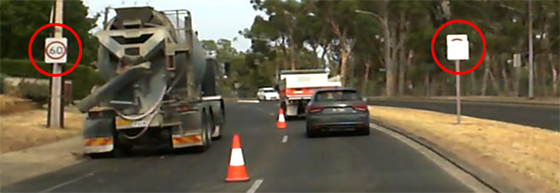
Figure: The images above show inconsistencies in speed limit posting which affects the safety of road workers and users.
Traffic Response Officers have seen a rise in posted speed limit signs that conflict with the lowered speed reductions at a work site.
The SA Standards for Workzone Traffic Management Section 5.2.1 requires that any signs and traffic control devices which are inappropriate to or conflict with the temporary work site situation must be covered, obliterated or removed. This includes regulatory, warning or guide signs, and pavement markings. This should be indicated in the traffic guidance scheme.
This is also a requirement within the permit conditions - see condition 9.10:
If a speed reduction at the work area or work site is required, any relevant permanent posted speed limit sign (or any advisory posted speed sign) must be appropriately covered so as to clearly indicate to all road users that the temporary reduced speed signage is the applicable speed limit past the work area or work site as required for the duration of the permit and reinstated when it no longer conflicts or is inappropriate.
Be alert for the national AusAlert test
The Australian Government will launch AusAlert, a new national emergency warning system, in October 2026.
Before AusAlert is launched, it will be tested to make sure it works as intended.
A national test is planned for 1.30pm ACST (local time) on Monday, 27 July 2026.
What will happen
The national test will send a test Critical Alert, which is expected to be received by all compatible mobile devices. This follows local community-based tests held across Australia throughout June this year.
The Critical Alert may cause a vibration and a siren-like warning sound even if your device:
- is set to ‘silent’ or ‘do not disturb’
- does not have a working SIM card.
You cannot opt out of receiving Critical Alerts.
What to do
As this is only a test, no action is required. Do not call Triple Zero (000).
If receiving the Critical Alert may cause stress or harm, and you do not want to receive it, you will need to turn your device off or switch to aeroplane/flight mode and remain in aeroplane/flight mode for at least one hour after the alert.
If you receive the test alert while driving or operating machinery, stay calm and do not touch your device.
Devices connected to in-vehicle audio systems may amplify the sound during the test. If this is of concern to you, please disconnect your device from your vehicle's audio system before the test.
Mobile phone laws still apply – do not touch your device or read the alert while your vehicle is moving.
Only check the AusAlert message when it is safe and legal to do so.
About AusAlert
AusAlert is another way the Australian Government is helping to keep Australians safe.
AusAlert uses the latest cell-broadcast technology to send near-instant emergency messages to compatible mobile devices. This is considered international best practice.
Cell-broadcast technology sends a mass broadcast from a nearby mobile phone tower. It does not send messages to mobile numbers like SMS systems do.
AusAlert could be used during:
- natural hazards such as bushfires, floods and storms
- significant events such as public health emergencies, public safety or biosecurity incidents.
To learn more about AusAlert visit ausalert.gov.au.
TTM training transition period deadline
The 3-year transition period to give everyone time to obtain new TTM qualifications is fast approaching.
The relevant qualification for your TTM duties needs to be updated and aligned with the national training network by 1 February 2027.
This applies to:
- Traffic Controllers
- Traffic Management Implementers
- Traffic Management Designers.
You may be able to obtain your qualifications via a Recognition of Prior Learning (RPL) assessment. Be aware that approved training providers may take several weeks or longer to review submitted evidence for each qualification.
Whether you are attending face-to-face classroom training or RPL, don’t leave it till the last minute to complete all requirements.
You will not be able to work on a road unless you have a current qualification.
No extentions will be given on old qualifications.
Learn more about the National Training Framework for Temporary Traffic Management.
New digital TTM cards
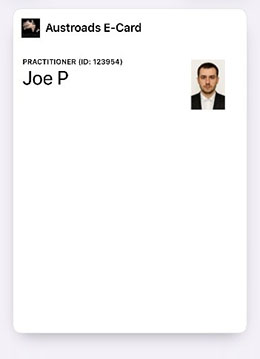
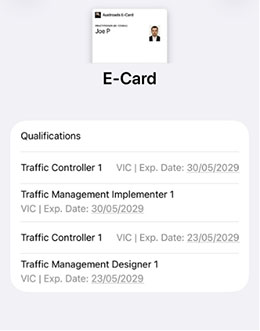
Figures: Examples of the new digital card which replace the plastic TTM cards.
Austroads is now issuing digital cards for all TTM qualifications. All your qualifications will be added to the digital card, including any interstate qualifications.
We will no longer issue the plastic TTM cards unless you have lost your old workzone traffic management card.
Outcome of TTM Skill Set Minor Project
Between January and April 2026, BuildSkills Australia undertook a review of the skill set and entry requirements for the below TTM skill sets:
- RIISS00058 Traffic Controller Skill Set – Urban Streets and Low Volume Rural Roads
- RIISS00059 Traffic Controller Skill Set for High Volume Roads
- RIISS00061 Traffic Management Implementer Skill Set for High Volume Roads.
Following consideration of the consultation feedback and evidence gathered throughout the project, BuildSkills Australia has determined that the proposed changes will not proceed through this minor project.
While stakeholders identified workforce shortages and barriers to progression, particularly across large-scale projects and regional and remote areas, consultation also highlighted the importance of maintaining training requirements that support safe workplace outcomes.
BuildSkills Australia does not support changes to training products where there is a risk they may compromise an individual's ability to work safely.
Workforce challenges currently facing the sector were acknowledged however, consultation indicated that many of these issues extend beyond the scope of vocational training products alone.
Understanding both the workforce challenges and safety concerns, BuildSkills Australia welcome your input into looking at a potential major project in the future.
For further details relating to the review, please see the project page.
Future Topics
If you have topics of interest or clarification for industry as a whole please forward your suggestions to DIT.TASSAdminSupport@sa.gov.au.