
Eyre Peninsula Grain Export Supply Chain Planning Study
About the study
Following changes in the export grain industry and the shift away from grower‑based traders and bulk handlers, several new grain port proposals have emerged in South Australia, particularly on the Eyre Peninsula. Lucky Bay Port near Cowell opened in 2020, while proposed direct‑loading facilities at Cape Hardy and Port Spencer have not yet secured investment.
The rail freight network was upgraded in 2006 through joint industry and government funding, supported in part by a grower levy. However, the 2016 Eyre Peninsula Freight Study found that rail was no longer commercially viable for grain. Rail haulage ended in 2019, shifting all grain transport onto roads and increasing pressure on local road networks and Port Lincoln. Councils have raised concerns about higher freight volumes and the resulting road maintenance impacts. Proposed new ports on the lower Eyre Peninsula have added to these concerns, as many connecting council roads remain unsealed. These issues are closely tied to future decisions about port, road and rail investment.
In 2023, Aurizon and Viterra (now Bunge) prepared a business case to redevelop the rail‑based supply chain, including new grain loading and discharge facilities. Submitted to both the Australian and South Australian Governments, the proposal aims to improve supply chain efficiency and increase grower returns. It would lift annual rail grain volumes to Port Lincoln from around 700,000 tonnes to approximately 1.2 million tonnes.
Study scope and outcomes
The study focused on the grain supply chain from farm to local storage, considering grower needs such as harvest logistics, market conditions, product quality, and segregation, with some consideration of the impacts of multiple handling.
The study:
- Developed an effective and practical export grain supply chain by examining different transportation methods and network configurations.
- Reviewed bulk grain logistics across the Eyre Peninsula, including access to Port Lincoln, Thevenard and Lucky Bay.
- Considered grower and community outcomes, including heavy vehicle traffic, impacts on council roads, and effects on regional communities.
Overall, the study identified an optimal export grain supply chain and noted that some solutions could support other commodities in the future.
Community engagement
We sought feedback on current freight movements, future investment needs, and the implications of rail on existing and planned investments, including those not rail‑related. We also gathered views on impacts to local east–west road networks, particularly considering proposed new ports on the lower Eyre Peninsula.
Read the What We Heard for further details about this consultation.
Next Steps
The study has identified a range of potential infrastructure investment opportunities to improve grain supply chain efficiency and support future growth in grain production on the Eyre Peninsula.
The next phase will involve building on the planning study completed to date through the development of a Full Business Case, which will further assess the preferred options, costs, benefits, risks and implementation requirements.
Implementation of any future infrastructure investment would be subject to further engagement and agreement with key industry stakeholders, including Bunge and Aurizon. Progression beyond the business case stage would also depend on the availability of government and industry funding and the outcomes of detailed economic, technical and commercial assessments
Road and Rail Network
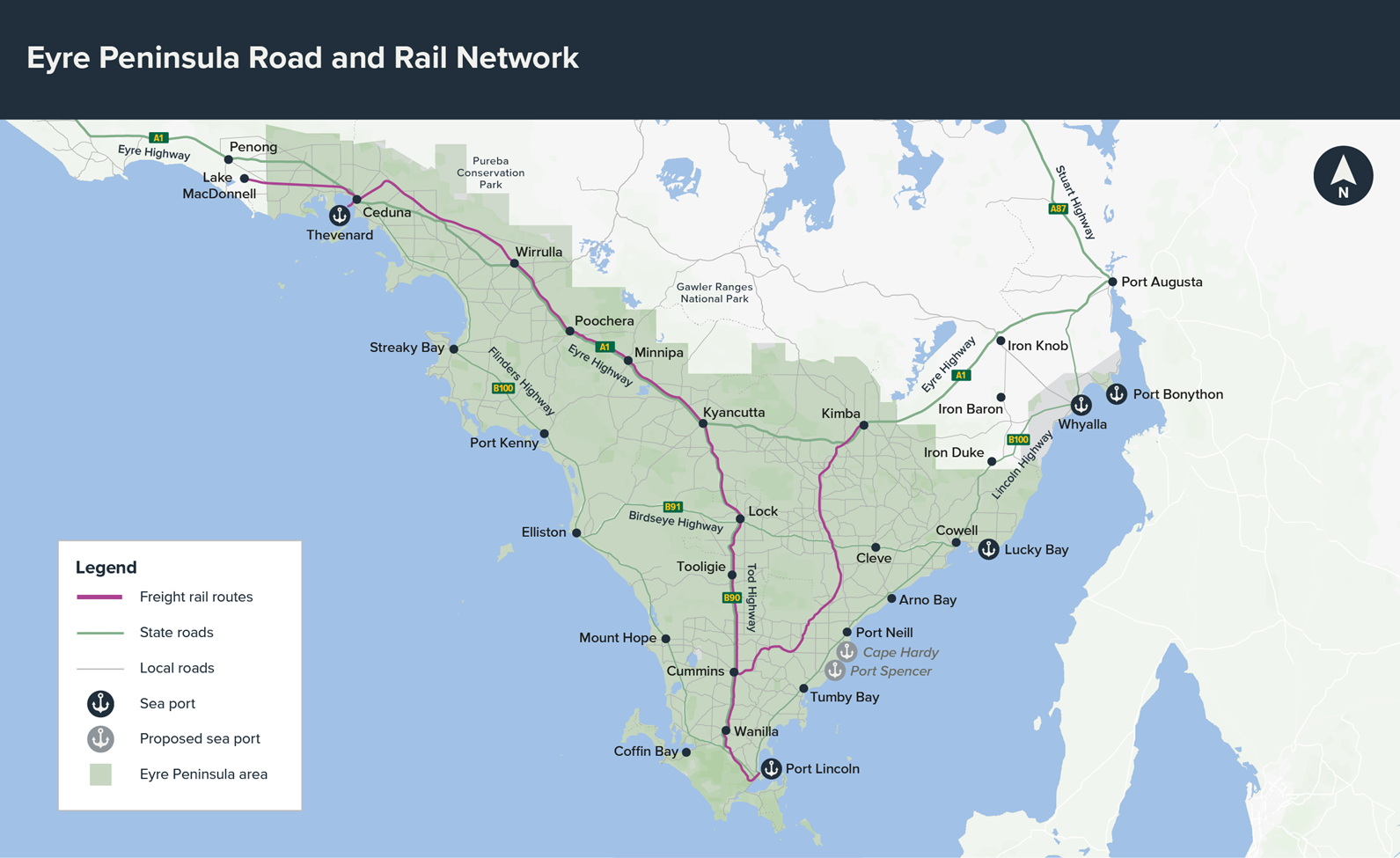
The map highlights major freight rail, state roads, local roads and seaports on the Eyre Peninsula.
Subscribe to project updates
Our privacy statement outlines what information we collect, how we use it and store it.
You can unsubscribe using the link in the email.


Fast facts

Status
In Planning

Location
Eyre Peninsula

Funding
Jointly funded (75:25) by the South Australian Government and the Eyre Peninsula LGA