
Annual report 2024–2025
Our 2024–2025 annual report is on this page. The information is correct as at 30 September 2025.
You can also download the print version: Department for Infrastructure and Transport 2024–2025 Annual Report (PDF, 30.9 MB).
The print version contains:
- Appendix 1: Audited financial statements
- Appendix 2: Contractors engaged by the agency.
Submission
To:
Hon Tom Koutsantonis MP
Minister for Infrastructure and Transport
Hon Stephen Mullighan MP
Minister for Police
This annual report will be presented to Parliament to meet the statutory reporting requirements of the Public Sector Act 2009, the Public Finance and Audit Act 1987, and other relevant Acts and the requirements of Premier and Cabinet Circular PC013 Annual Reporting.
Incorporated in this document is annual reporting by the Commissioner of Highways under the provision of the Highways Act 1926, and by the Rail Commissioner under the provision of the Rail Commissioner Act 2009.
This report is verified to be accurate for the purposes of annual reporting to the Parliament of South Australia.
Submitted on behalf of the Department for Infrastructure and Transport by:
Jon Whelan
Chief Executive
Date: 30 September 2025
From the Chief Executive

The Department for Infrastructure and Transport has continued to serve the people of South Australia through the delivery, planning and implementation of key projects and initiatives during 2024‑2025.
Throughout the year, the Department remained focused on successfully delivering infrastructure projects, transport improvements and essential services to improve the lives of South Australians.
This included work in road transport and marine infrastructure, as well as social infrastructure such as schools, hospitals and other key initiatives important to communities right across our State.
We continued to develop and manage road and marine legislation, along with campaigns and strategies to help keep South Australians safe.
The delivery of high quality public transport services was again an important focus for our Department. We reached a major milestone in the return of train services to public hands and we introduced several new public transport services such as the Port Dock spur line and the Hills Expansion Bus Services.
In the infrastructure space, advances in bringing the $15.4 billion River Torrens to Darlington Project to life have been significant.
Key moments included the awarding of a contract to the Alliance made up of John Holland, Bouygues, Arcadis, Jacobs and Ventia to deliver the project in conjunction with the Department. Works are well underway at a number of construction precincts along South Road, on our broader network upgrades and at the precast facility at Waterloo Corner.
This is the biggest infrastructure project ever undertaken in South Australia.
Not only will the project complete 78 km of non-stop travel from Gawler to Old Noarlunga, bypassing 21 sets of traffic lights, but it will also improve east-west connectivity and provide new public space for local communities.
Work also continued on the $870 million Tram Grade Separation Projects, where we are removing three congested tram level crossings and building new overpasses at Plympton and Morphettville and also rebuilding the South Road Tram Overpass to accommodate the River Torrens to Darlington Project lowered motorway.
Around 51,000 vehicles pass through the Marion Road and Cross Road level crossings each day and roughly 25,600 vehicles pass through the Morphett Road level crossing.
During peak hours, the boom gates are down for up to 20 minutes each hour at Marion Road and Cross Road and 16 minutes at Morphett Road.
The removal of these crossings will dramatically reduce congestion and provide huge benefits for motorists. The works are supporting 1,115 jobs during construction.
Contracts have also been awarded to deliver $150 million upgrades of the Mount Barker and Verdun Interchanges on the South Eastern Freeway, with major construction set to begin in late 2025.
Upgrading the two interchanges will improve safety and traffic flow for the thousands of motorists who travel every day between the city and Adelaide Hills communities, including Mount Barker.
Work also continued on the $120 million construction of new on/off ramps for the Southern Expressway at Majors Road. A key milestone was reached earlier this year with the installation of 18 South Australian-made girders for the widening of the Majors Road bridge.
When completed, this project will provide commuters in the southern suburbs better access to the Southern Expressway, significantly decreasing travel times. Visitors to the area will also benefit through improved access to Glenthorne National Park – Ityamaiitpinna Yarta, Sam Willoughby International BMX Facility and the Southern Soccer Facility from the Southern Expressway.
Work on the refit of Heysen Tunnels was completed on schedule, with major testing of all safety systems and equipment completed in February.
The upgrade addressed tunnel elements that were at the end of their service life after over two decades of use. It also improves safety, along with traffic management and incident response capabilities.
Work on the Fleurieu Connections Projects also advanced, with the completed new Aldinga Bridge opened to traffic in March. This was a notable milestone in the Fleurieu Connections duplication of Main South Road between Aldinga and Sellicks Beach.
This duplication, which follows the successful completion of the Stage 1 duplication of South Road and Victor Harbor Road, will deliver further benefits for the Fleurieu Peninsula region, as this vital tourism gateway is made increasingly accessible.
As always, our work on regional roads was extensive as we continued to roll out upgrades across the State. The Department manages a range of road related assets, including approximately 13,000 km of sealed roads, 10,000 km of unsealed roads, 742 bridges and over 100,000 electrical assets including lighting and Variable Message Signs.
Flood recovery investment to improve National Supply Chain Resilience program focuses on flood recovery and improving the flood resilience in the far north. The program includes upgrades to these flood impacted areas: Olympic Dam Highway; Eyre Highway, west of Kimba; and Stuart Highway at Glendambo, Woocalla Creek and Lake Windabout. The works will raise the level of the existing road surface to mitigate the change of water overlapping and closing the road, increase in the number of drainage structures and provide scour protection and rock armour along the batter slopes.
Work was also completed on key regional highway corridors, including the Horrocks, Sturt, Princes, Eyre and Augusta highways.
Importantly for the people of Kangaroo Island, the Department continued our works on Penneshaw and Cape Jervis ports. This is a vital project for an internationally renowned South Australian tourism destination.
Work also continued on a variety of important social infrastructure projects.
Construction of the new, world-class Adelaide Aquatic Centre has continued and will open in Summer 2025-2026, as planned. As well as providing a fantastic new facility for the people of South Australia, this project is also returning more than 1,000 square metres of Park Lands to the community.
In the health sector, work continued on the Flinders Medical Centre Redevelopment, as well as the new Mount Barker Hospital, which will deliver vital services for the rapidly expanding Adelaide Hills community.
Construction continued on the new South Australian Ambulance Service Precinct, which will provide an Emergency Operations Centre and State Health Control Centre.
We also proudly completed construction of new South Australian Ambulance Service stations at Victor Harbor, Edwardstown, Golden Grove and Mount Barker, while continuing construction at Campbelltown and Gawler.
Construction continued on various South Australia Police facilities to accommodate the relocation from Thebarton Barracks.
A number of important strategies that will benefit our State for many years to come were finalised and launched during the year.
South Australia’s first Transport Strategy was released, outlining a 30-year vision to transform how people and goods are moved around the State. The Transport Strategy is a visionary document that sets the overall direction for future transport planning. It will guide decisions on which projects need to be prioritised and invested in, while future-proofing our transport network to ensure South Australia remains the best place in the nation to live and work.
The Strategy was shaped by South Australians, with more than 6,000 people from across the State providing input into the plan during a thorough community engagement process.
The new South Australian Recreational Boating Safety Strategy 2025-2030, was also released, setting out how boating safety will be improved on our coastal and inland waters over the next five years.
Recreational boating plays an important part in the South Australian way of life and we are proud to have delivered a strategy that will assist in keeping our community safer on the water.
Our Service SA centres provided vital services for South Australians, continuing our focus on quality customer service so that South Australians can conduct necessary transactions conveniently, efficiently and effectively.
One of the important initiatives this year was a new collaboration between the State Government and Hutt St Centre to help vulnerable people, including those experiencing homelessness, rebuild their lives.
Under the partnership, Service SA staff attended the Hutt St Centre once a fortnight to assist people with essential life administration tasks, offering a safe and accessible way to access identification documents.
A further initiative was a recent decision to continue a quiet-hour option in select Service SA centres to remove barriers faced by neuro-divergent people.
In September 2024, an auction of historic licence plates was undertaken with great success. The highlight of the sale was the much-desired number 8 plate, which sold for a record-breaking $2.3 million.
As part of our dedication to providing quality public transport, in February 2025, we very proudly fulfilled the State Government election commitment to return train services to government hands.
This historic de-privatisation was uncharted territory, and many questioned whether it was possible. The success of the transition back to government hands is a testament to the hard work of Departmental staff.
Work also continued on the return of tram services to public hands, which will occur on 31 August 2025.
The Department also completed the $51 million Port Dock Railway Line Project, which was officially opened in August 2024. This project re-established the 1 km spur line and train station which were previously decommissioned in 1981.
It now provides an important rail connection for those living in the area, as well as the many more set to live, work and visit historic Port Adelaide into the future.
We have remained committed to the safety of all public transport staff and our passengers.
In an Australian first, the Department developed legislation to grant stronger powers to combat criminal and anti-social behaviour on public transport. This included time‑limited bans and indefinite bans for people charged with certain criminal offences. These new measures send a strong message to the small minority of people who do the wrong thing on public transport, that anti-social behaviour will not be tolerated.
During the year, we made significant progress on delivering a faster rollout of protective screens to help keep our bus drivers safe. We are now working towards completion of this important work by the end of 2026.
The Northern Water Project Delivery Office joined the Department in July 2024. The project includes a desalination plant and hundreds of kilometres of pipeline, and aims to provide a new, climate independent water source for South Australia's Far North, Upper Spencer Gulf, and Eastern Eyre Peninsula to support regional growth in exploration and mining, and other industries. During 2024-2025, work continued to inform the reference design, cost estimate and the approvals pathway, to ensure high quality procurement process outcomes.
Throughout the year, our community engagement team directly engaged with more than 16,000 South Australians across the State as we shaped and delivered infrastructure and transport projects. This included distributing 440 project updates and hosting 124 community events that were attended by 3,200 people across 59 locations. We also used social media to engage with our communities, publishing 3,160 posts across our 20 social media accounts. These posts were viewed 38.9 million times and attracted 169,000 engagements (reactions, comments and shares), as our total follower base grew to almost 200,000 people.
We have also continued to advance our Reconciliation Action Plan, which includes comprehensive training for all staff.
The 10th anniversary of the important On The Right Track program was another significant achievement. This initiative helps First Nations people in remote communities to obtain their driver’s licence, including the option of Medium Rigid truck licence training in specific cases.
In recognition of National Reconciliation Week, we were also proud to have one of our trams displaying artworks by Aboriginal artists Presten Warren, Violet Buckskin and Jaylene Ware.
The Traffic Management Centre took approximately 170,000 calls in 2024‑2025. These calls were received range from members of the public, work zone traffic management industry, emergency services and other service authorities.
In January 2025, South Australia’s Road Safety Action Plan 2025-2027 was released online. The Action Plan builds on the previous 2023-2025 Action Plan and responds to emerging trends in road crash data and developments in research and technology which support new solutions. As part of the road safety initiatives supported by the Action Plan, a new Bicycle and Pedestrian Actuated Crossing was opened at the intersection of South Road, Roebuck Street and King Street at Mile End and a new Pedestrian Actuated Crossing was switched on at Lyndoch Road, Gawler to improve safety for children travelling to and from Immanuel Lutheran School. A further 17 cycling and pedestrian infrastructure projects, jointly funded by the Australian and South Australian governments, as part of the Road Safety Program were also announced.
As part of the Action Plan’s Road User Behaviour focus, we enabled learner drivers to take their Hazard Perception Test online, from October 2024, improving convenience and streamlining the process for those wanting to obtain their provisional licence in their own time. The online version has had over 13,000 enrolments and provides novice drivers with the flexibility to complete the test anytime, anywhere. The test assesses a driver’s ability to recognise and identify potential hazards on the road and react appropriately, including with other road users such as drivers, riders, pedestrians and cyclists.
The Action Plan is also improving safety for motorbike riders through enhancements to the Rider Safe Program introduced in December 2024. The new program has an increased focus on safety awareness, judgement and decision making and requires riders to successfully pass double the training that was previously required. More than 1,800 people have completed the new online course and almost 400 people have completed the pre-licence practical course in the first seven months.
Between December 2024 and February 2025, we ran a campaign to encourage South Australians to buy the safest car in their budget. This campaign targeted older drivers, younger drivers and their parents and drivers in regional and remote areas who are more likely to be driving older cars with fewer safety features. Vehicles and technology are a focus in the Action Plan because newer safer vehicles can help reduce crashes and reduce the chance of serious injury of any crashes that still occur.
In February 2025, we made a change to improve safety of Heavy Vehicles when two State-based measures to improve heavy vehicle licensing arrangements came into effect, the Multi-Combination Licence Program, and the change to no longer recognise overseas heavy vehicle driving experience toward obtaining a Multi-Combination licence, other than from New Zealand. These new measures will help improve heavy vehicle driver competency.
This has been another big year for the Department for Infrastructure and Transport.
I thank all Departmental staff for their dedication, ingenuity and professionalism as they have continued to tackle the important projects and complex issues to help advance our State.
I am immensely proud of all of the projects, services and initiatives that we have worked together to successfully deliver in 2024-2025.
Jon Whelan
Chief Executive
Department for Infrastructure and Transport
Overview: about the agency
Our strategic focus
| Our Purpose | We connect South Australians to keep our State moving – now and for the future. |
|---|---|
| Our Vision | Every South Australian can easily access the services they want, the transport they rely on and the infrastructure they need. |
| Our Values | To build with purpose, move with care and connect with community for all South Australians. |
Our functions, objectives and deliverables
Transport Strategy and Planning
Shapes South Australia’s transport future with transport strategies, infrastructure projects and investment programs enabling State prosperity, sustainability and connectivity.
The division is focused on delivering:
- Transport strategies and plans.
- An investment pipeline with transport infrastructure project plans and designs.
- Data, technical and customer insights to better inform transport services.
- Strong governance and oversight of transport investment programs and infrastructure projects.
Infrastructure Delivery
Deliver and integrate social and transport infrastructure safely and efficiently to sustain and support growth and maximise the benefit of government’s investments.
The division is focused on delivering:
- Fit for purpose social and transport infrastructure that is responsive, meets customer needs and generates economic and community orientated benefits and outcomes.
- Whole of lifecycle solutions developed and delivered collaboratively with colleagues, industry and key stakeholders.
- Leading practice and innovation in safety, environmental management, sustainability, procurement, design, engineering and delivery.
- Effective governance and project controls to ensure Departmental compliance against relevant legislation, standards, Code of Ethics and policies as well as on time and on budget delivery.
North-South Corridor Program Delivery Office
Develops the plans and oversees the delivery of infrastructure needed to complete the final stage of the North-South Corridor, the River Torrens to Darlington Project, which will deliver a non‑stop South Road. The division is focused on delivering a project which:
- Significantly contributes to economic development.
- Improves liveability, connectivity and facilitates jobs growth.
- Delivers travel time savings and boosts productivity.
- Improves road safety.
Road and Marine Services
Connects our communities by enabling safe, reliable and efficient movements and flows of goods, services and people across the State’s road and marine networks. The division is focused on delivering:
- Safe and reliable road and marine infrastructure operated and maintained to maximise economic and community benefit.
- Optimised networks, with data driven solutions, that optimise overall performance in movement of goods, services and people.
- Forward thinking policies, strategies and programs based on stakeholder engagement and evidence that will enable safe, inclusive, productive, efficient and sustainable transport.
- Service delivery that meets customer needs and expectations.
Public Transport South Australia
Customer-focused public transport and better maintained State assets in partnership with our service providers, delivering:
- Integrated end-to-end journeys with easier access and information, payments and navigation enabled by new technologies.
- A clear plan for growth that makes the case for investment in new public transport assets and transitions them into service efficiently.
- Initiatives which support the State Government’s goal to achieve net zero emissions by 2050.
- Better public transport networks that attract more customers.
- Improved customer experience through simple, safe and easy-to-use public transport services to attract and retain customers.
- Continued improvement of public transport assets that enhance accessibility, safety and security.
- Deliver high quality train services through effective, efficient, and safe operational practices that prioritise on-time performance, customer satisfaction and the reliability of the network.
- Maintain a high level of customer service by ensuring all frontline staff are visible, well informed and responsive, creating a welcoming and supportive environment for all passengers, while actively managing disruptions and keeping service reliability as high as possible.
Transport Policy and Regulation
Connects our communities by delivering policy initiatives, community information and provision of services for safe road use and travel behaviour by overseeing regulatory, road safety and policy responsibilities and delivers customer-focused services through Service SA:
- Forward thinking policies, strategies and programs based on stakeholder engagement and evidence that will enable safe, inclusive, productive and sustainable road use and travel behaviour.
- Effective regulation of access and usage that assures safety and sustainability, with clear boundaries reflecting reasonable expectations.
- Service delivery that meets customer needs and expectations.
Commercial and Contract Management
Responsible for procurement of civil construction projects and contract management and commercial advisory of these projects and the Department’s road maintenance contracts, to ensure delivery is undertaken in accordance with the contracted requirements. The division is focused on:
- Procuring civil infrastructure and maintenance projects.
- Ensuring contractors perform contracted works in accordance with the terms of their contracts.
- Protecting the public interest in the delivery of infrastructure and maintenance projects by holding contractors to account to ensure that works are delivered within budget.
- Delivering contract management services that serve as a model for contract management throughout government.
- Maintaining effective procurement governance and contract management controls.
Public Affairs
Listens, informs, communicates and works with customers and stakeholders to guide our agency to deliver improved outcomes for our economy, our community and our State. The division is focused on delivering:
- Social value by putting people at the centre of everything we do, ensuring we deliver better outcomes for customers, stakeholders and the community.
- Trusted advice and services to government, supporting our business partners to ensure goals are achieved.
- Accurate, transparent and timely communications, with a focus on building our social licence and enhancing the Department’s reputation.
- A positive organisational culture that promotes the Department as a workplace of choice.
People and Corporate Services
Provides systems and assurance processes for managing our people, our finances, our performance and risk, ensuring we can work safely, efficiently and productively. The division is focused on delivering:
- A high-performance organisation that is enabled by well-designed systems, processes, and technology, with effective management frameworks that enable efficient work practice.
- Effective control frameworks that ensure ongoing compliance with all relevant legislative, regulatory and policy requirements.
- Provision of valuable advice and user orientated services that support business partners enabling them to deliver an engaging work environment with a clear focus on safety, flexibility, productivity and progressive practices.
- A skilled, motivated, diverse workforce demonstrating our values in their actions.
Northern Water Project Delivery Office
Oversees the pre-delivery and procurement of the Northern Water Project which aims to deliver a large-scale desalination plant in the Upper Spencer Gulf, supporting industrial growth and reducing reliance on unsustainable water sources. The Division is dedicated to the successful delivery of the pre-delivery and procurement phase of the project which focuses on:
- Conducting a robust procurement process for the Northern Water Project Design Build Operate Maintain Contract.
- Obtaining the necessary primary approvals for the Project.
- Managing the site investigations and integration works.
- Securing the land for the Project delivery.
Office of the Chief Executive
The Office of the Chief Executive is responsible for the delivery of a comprehensive range of professional, strategic and responsive executive support services to the Chief Executive and the Executive team, with a strong focus on driving strategic priorities and objectives for the Department and government.
The Office of the Chief Executive provides a key customer service and interface with Ministerial Offices, to ensure the provision of accurate and timely information.
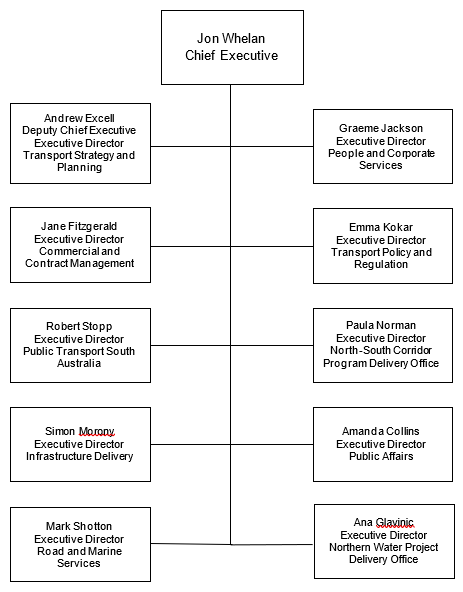
Our organisational structure
Reporting directly to the Chief Executive for 2024-2025:
- Andrew Excell, Deputy Chief Executive, Executive Director, Transport Strategy and Planning.
- Paula Norman, Executive Director, North-South Corridor Program Delivery Office.
- Simon Morony, Executive Director, Infrastructure Delivery.
- Emma Kokar, Executive Director, Transport Policy and Regulation.
- Ana Glavinic, Executive Director, Northern Water Project Delivery Office.
- Mark Shotton, Executive Director, Road and Marine Services.
- Robert Stopp, Executive Director, Public Transport South Australia.
- Jane Fitzgerald, Executive Director, Commercial and Contract Management.
- Graeme Jackson, Executive Director, People and Corporate Services.
- Amanda Collins, Executive Director, Public Affairs.
Changes to the agency
During 2024-2025, the agency’s structure changed as a result of internal reviews or machinery of government changes.
Creation of new Divisions
- Public Transport South Australia
- Northern Water Project Delivery Office
Restructured Divisions
- North-South Corridor Program Delivery Office
- Infrastructure Delivery
- South Australia Public Transport Authority to Public Transport South Australia
- Transport Strategy and Planning Division
- Public Affairs
Machinery of Government
- Transfer of Office of Local Government to the Department for Housing and Urban Development
- Transfer of Northern Water Project Delivery Office to the Department
- Part of Northern Water Project Delivery Office transfer to the Department of Treasury and Finance
Our Ministers
 | The Hon Tom Koutsantonis MP is the Minister for Infrastructure and Transport. Minister Koutsantonis oversees transport systems and services, and infrastructure planning and provision. |
 | The Hon Stephen Mullighan MP is the Minister for Police. This portfolio also includes responsibility for Road Safety. The Minister oversees road safety initiatives to improve road user safety outcomes in South Australia. |
Legislation administered by the agency
Minister for Infrastructure and Transport
Adelaide Oval Redevelopment and Management Act 2011
Adelaide Railway Station Development Act 1984
Aerodrome Fees Act 1998
Air Navigation Act 1937
Air Transport (Route Licensing—Passenger Services) Act 2002
Alice Springs to Darwin Railway Act 1997
AustralAsia Railway (Third Party Access) Act 1999
Civil Aviation (Carriers' Liability) Act 1962
Commissioner of Public Works Incorporation Act 1917
General Tramways Act 1884
Golden Grove (Indenture Ratification) Act 1984
Government House Precinct Land Dedication Act 2016
Harbors and Navigation Act 1993
Heavy Vehicle National Law (South Australia) Act 2013
Highways Act 1926
Land Acquisition Act 1969
Marine Safety (Domestic Commercial Vessel) National Law (Application) Act 2013
Maritime Services (Access) Act 2000
Metropolitan Adelaide Road Widening Plan Act 1972
Mile End Underpass Act 2005
Mobil Lubricating Oil Refinery (Indenture) Act 1976
*Morphett Street Bridge Act 1964
Motor Vehicles Act 1959
National Soldiers Memorial Act 1949
Non-Metropolitan Railways (Transfer) Act 1997
North Haven Development Act 1972
North Haven (Miscellaneous Provisions) Act 1986
Oil Refinery (Hundred of Noarlunga) Indenture Act 1958
Passenger Transport Act 1994
Proof of Sunrise and Sunset Act 1923
Protection of Marine Waters (Prevention of Pollution from Ships) Act 1987
Public Employees Housing Act 1987
Rail Commissioner Act 2009
Rail Safety National Law (South Australia) Act 2012
Rail Transport Facilitation Fund Act 2001
Railways (Operations and Access) Act 1997
Railways (Transfer Agreement) Act 1975
Road Traffic Act 1961
South Australian Ports (Bulk Handling Facilities) Act 1996
South Australian Ports (Disposal of Maritime Assets) Act 2000
*Steamtown Peterborough (Vesting of Property) Act 1986
*Tarcoola to Alice Springs Railway Agreement Act 1974
Terrorism (Surface Transport Security) Act 2011
Victoria Square Act 2005
Waite Trust (Vesting of Land) Act 2020
West Lakes Development Act 1969
*Denotes Act of limited application
The agency's performance
Performance at a glance
During 2024-2025, the Department achieved the following:
- Awarded the Main Work Alliance contract for the River Torrens to Darlington Project on 13 September 2024.
- Continued to advance enabling works for the River Torrens to Darlington Project including utilities services relocations, as well as land acquisition and network upgrades.
- Released the Forward Work Plan: Major Programs 2024-2027.
- Released of South Australia’s first Transport Strategy.
- Undertook stakeholder and community engagement for the development of South Australia’s Public Transport Strategy.
- Completed the High Productivity Vehicle Network strategic business case and developed Stage 1 upgrades for the high productivity vehicles network.
- Progressed transport planning studies for the Northern Adelaide Growth Areas, mass Passenger Transport to Mount Barker, potential rail network extensions, Adelaide’s Inner and Outer Ring Route and the Department’s Strategic Asset Management Plan.
- Completed the Roma Mitchell Secondary College expansion, Valley View High School redevelopment, Para Hills STEAM upgrade, Ceduna Area School Special Education Unit.
- Commenced main construction on the new Mount Barker Hospital.
- Continued construction on the South Australian Ambulance Service Precinct, to provide an Emergency Operations Centre and State Health Control Centre.
- Completed construction of new South Australian Ambulance Service stations at Victor Harbor, Edwardstown, Golden Grove and Mount Barker.
- Continued construction to support the relocation of South Australia Police from the Thebarton Barracks precinct.
- Commenced construction of the Adelaide Women’s Prison.
- Continued construction of the new Adelaide Aquatic Centre.
- Continued works on the Tram Grade Separation Projects.
- Completed the Heysen Tunnel Refit and Safety Upgrade.
- Continued construction works of Kangaroo Island Ports Upgrade Project.
- Continued construction of the Majors Road Interchange on-off ramps on the Southern Expressway.
- Opened to traffic the new dual carriageway from Port Wakefield to Lochiel as part of the Augusta Highway Duplication Project.
- Continued construction of Main South Road Duplication Project (Aldinga to Sellicks Beach) Stage Two, as part of the Fleurieu Connections projects.
- Continued works on regional road networks including the Augusta, Barrier and Stuart Highways and on the upgrade of the Strzelecki Track.
- Introduced new and expanded bus services to Mount Barker.
- Commenced a review of Regional Public Transport Services to enhance public transport services for people living in regional South Australia.
- Returned the control of metropolitan train services to public hands, with continued work to do the same for trams.
- Finalised a competitive two-phase procurement process for the 19 regional bus services contracts.
- Commenced rollout of new protective bus driver security screens on government owned buses.
- Established the Northern Water Project Delivery Office and re-commenced the procurement process for the Northern Water Project’s Design Build Operate Maintain contract.
- Procured and awarded multiple pre-delivery and support services contracts in support of the Northern Water Project.
- Established a new U class licence and online course to drive an ultra high powered vehicle.
- Introduced new State based initiatives to improve heavy vehicle driver competency and safety.
- Continued the delivery of the Way2Go program.
- Progressed significantly our Closing the Gap targets, including funding and in‑kind support for South Australian Aboriginal Community Controlled Organisations as well as driver licence training and testing models and programs to increase the number of licensed Aboriginal drivers.
- Released South Australia’s Road Safety Action Plan 2025-2027.
- Released the Passenger Transport Act review report in August 2024 and subsequent passage of legislation to implement recommendations.
- Legislation to allow the use of e-scooters and other personal mobility devices on footpaths, bike paths, and many bike lanes and roads.
- Legislation passed for Driver Training Reforms.
- Raised $4.1 million in a number plate auction held in August 2024. The auction released 28 plates for sale, including plate 8 which sold for $2.3 million.
- Raised $84,000 in a Japanese Special Edition Plate auction held in February 2025, with 15 plates released for sale.
- Service SA handled a total of 31,824,761 transactions (including enquiries) across its key service delivery channels. Of these, 8,641,410 were transactions where a record was updated, payment made, or official document issued.
- Introduced a Quiet Hour at the five metropolitan centres open on Saturdays to assist neuro-divergent customers.
- The Department manages a range of road related assets, including approximately 13,000 km of sealed roads, 10,000 km of unsealed roads, 742 bridges and over 100,000 electrical assets including lighting, and Variable Message Signs.
- Removed restrictions on metropolitan rideshare and chauffeur drivers, allowing them to operate Statewide.
- Delivered South Australia’s Level Crossing Safety Strategy 2025-2034 and released South Australia’s Level Crossing Safety Action Plan 2025-2028.
- Launched the first ever South Australian Recreational Boating Safety Strategy.
- Continued to administer the $2 million State Bicycle Fund, which enables local councils to build and improve bike paths and lanes.
- Completed works on the installation of a signalised intersection and pedestrian crossing at the John Rice Avenue and Haydown Road junction.
- Commenced planning studies on metropolitan and regional rail extensions and the Riverland network flood resilience.
Agency specific objectives and performance
The Department is committed to the continued delivery of a multi-billion dollar pipeline of infrastructure investment, while implementing key reforms, supporting the continued growth of the South Australian economy and the social wellbeing of our communities.
| Agency objectives | Indicators | Performance |
|---|---|---|
Effective Planning Policy | Infrastructure Planning | Released the Forward Work Plan: Major Programs 2024-2027, outlining a four-year program of State Government infrastructure and transport projects across the State. Engaged with key stakeholders and over 6,000 members of the community to inform the development of South Australia’s first Transport Strategy, which was released in February 2025. Commenced stakeholder and community engagement for the development of South Australia’s Public Transport Strategy, which will set a 30-year vision for the State’s public transport system. Completed the High Productivity Vehicle Network strategic business case and developed Stage 1 upgrades to provide the necessary infrastructure to enable the high productivity vehicles network. Released the final master plans for the Cape Jervis and Penneshaw Harbour precincts. Progressed transport planning studies for the Northern Adelaide Growth Areas, mass Passenger Transport to Mount Barker, potential rail network extensions, Adelaide’s Inner and Outer Ring Route and the Department’s Strategic Asset Management Plan. Continued planning for transport infrastructure programs in partnership with the Australian Government including the Princes Highway, Black Spots Program, Safer Local Roads and Infrastructure Program, Level Crossing Removal Program and the Road Safety Program. Updated engineering Master Specifications and technical guidelines for safety barriers and light pole inspections. Provided technical advice for the North South Corridor project, mobile phone camera detection gantry structures, Dock One Pedestrian/Cyclist Bridge in Port Adelaide, Mount Barker Interchange and other major projects. Completed more than 600 heavy load bridge assessments, major repairs to Kidman Bridge on Henley Beach Road and repairs to other bridges, culverts and gantries as part of the Department’s Bridge Maintenance Program. Significantly upgraded the Department’s strategic transport model, geospatial mapping to support asset climate risk assessments and community consultations and collected vital information about our road network. Provided data, modelling and visualisation of information to inform evidence-based decisions for transport strategies and planning studies. Commenced planning for the Department’s Operational Carbon Management Plan. |
Efficient Transport Services | Customer Focused Services | Completed the Port Dock Railway Line, including a new station, plaza area, landscaping, Shared Use Paths, bus interchange and re-establishment of the one-kilometre rail spur; opened for revenue services on 25 August 2024. Continued railway station upgrades at Clarence Park and Goodwood, and completed upgrades at Marino, Nurlutta, West Croydon, Noarlunga and Ethelton stations. Introduced new bus services to service The Boulevard in Parafield Gardens. Introduced AM and PM peak express routes from Mount Barker via the South Eastern Freeway, including a new Go Zone with higher frequency services. Commenced a review of regional public transport services to enhance services for people living in regional South Australia. Expanded the $25 lifting fee to cover trips undertaken by people with a disability who rely on Access Taxis, to include all country Access Taxi drivers. Introduced two new State-based initiatives to improve heavy vehicle driver competency and safety, namely the Multi Combination Licence Program; and ending recognition of equivalent overseas heavy vehicle driving experience to progress to a Multi Combination licence. Finalised regulations that will allow riders over the age of 16 years to legally ride e‑scooters and other personal mobility devices on footpaths, bike paths and many bike lanes and roads from 13 July 2025. Processed approximately 16,000 applications for heavy vehicle access via the National Heavy Vehicle Regulator. Continued to maintain and operate 24/7 River Murray Ferry services. The free of charge services transport approximately 1.6 million vehicles across the River Murray annually. Sixteen Stay Afloat lifejacket maintenance clinics were run at boat ramps and events across the State, with 422 lifejackets checked and over 850 public interactions recorded. Out of the 422 lifejackets that were checked, 178 failed a component of the check and were supplied free replacement parts. |
Valuable Social and Economic Infrastructure | Customer Focused Services | Significant additional and dedicated services were provided for LIV Golf tournament held in February 2025 and the AFL Gather Round held in April 2025, which included two games in the Barossa. The election commitment to reverse the privatisation of train services was delivered smoothly on 2 February 2025. Finalised a competitive two-phase procurement process for the 19 regional bus services contracts in late 2024. Phase 2 included four of the remaining five contracts, which commenced on 1 November 2024. Installed smart validators on all diesel trains and 80% of Electric trains in readiness for smart ticketing to be rolled out across the train network. Installed external smart validators for the Tea Tree Plaza car park boom gate, enabling customers to use their Tap and Pay (EMV) ticket to exit the car park. Took delivery of the smart barrier gates in readiness for install at the Adelaide Railway Station. Conducted Round 3 of the South Australian Car Club Program, which provides grants to local car and motorbike clubs. Implemented the motorbike licensing Rider Safe reforms, including a series of education and on-range and on-road assessment components to improve road safety. Finalised the regulations that will allow riders over the age of 16 years to legally ride e-scooters and other personal mobility devices on footpaths, bike paths and many bike lanes and roads from 13 July 2025. Expanded the $25 lifting fee to cover trips undertaken by people with a disability who rely on Access Taxis, to include all country Access Taxi drivers. Continued the delivery of the Way2Go program, which promotes safer, greener and more active travel for primary school students and their communities. Legislation passed for Driver Training Reforms which will be implemented over the next two years and see Government Examiners undertaking all car licence testing. Established a Consultative Forum with industry stakeholders to inform implementation of the reforms. Released Adelaide 500 Commemorative 25-year anniversary number plates, with 25 plates released via public auction. Held a Numeric Plate auction in August 2024, with 28 plates released including plate 8. Held a Japanese Special Edition Plate auction in February 2025, with 15 plates released. Service SA made ongoing its program to provide services to vulnerable people, in partnership with the Hutt St Centre. Service SA introduced a Quiet Hour at the five metropolitan centres open on Saturdays. Made available online the Hazard Perception Test, improving convenience and streamlining the process for those wanting to obtain their licence in their own time. Made available online the transfer of recreational boat registrations. Removed restrictions on metropolitan rideshare and chauffeur drivers, allowing them to operate statewide. Launched the Outback Unsealed Roads Grading Program interactive map on the Department’s website. Repaired flood-damaged roads to improve resilience and connectivity for remote communities. Supported major tourist attraction events including the Tour Down Under, by ensuring the safety and quality of the road network for participants. Took delivery of Marine Patrol 1, the most advanced patrol vessel of its kind in the Southern Hemisphere, increasing the State’s emergency response and Marine Safety on-water patrol capabilities. |
Valuable Social and Economic Infrastructure | Enhancement of current transport infrastructure | Installed 11 bus shelters as part of an upgrade program. Delivered the Port Dock Railway Line Project, re-establishing the one-kilometre line and station including a new bus interchange at the existing Lipson Street car park. Ordered an additional 100 buses from Scania, consisting of 60 electric buses and 40 hybrid buses (due for delivery in 2026). Upgraded passive pedestrian maze at Nurlutta Railway Station, adjacent to Commercial Road, Salisbury. Also included improved access for people with disability to Nurlutta Railway Station. Constructed new active pedestrian crossing and improved station ramp at Clarence Park Railway Station. Upgraded Noarlunga Interchange, including improved amenity at the station, passenger information totem and a new escalator. Installed a Pedestrian Actuated (push button) Crossing at West Croydon near Kilkenny Primary School. Upgraded Woodlands Park Railway Station, including a new shelter, improved platform surface including tactiles and CCTV. Installed a new platform and upgraded connecting paths/ramps at Ethelton Railway Station. Converted 50 diesel railcars to hybrid battery diesel electric railcars. Installed Auxiliary Power Units for Flexity trams to convert the overhead power supply to usable power for air conditioning, lighting and passenger information. Refurbished the Belair Heritage Shelter proudly displaying its Heritage Colours. Commenced replacement of CCTV and Passenger Information Systems onboard trams. Installed tactile ground surface indicators for people with vision impairment at Largs and Midlunga railway stations. Improved artwork and landscaping at Parafield, Alberton and Christies Downs railway stations and improved landscaping at Seacliff and Largs railways stations. Undertook community engagement on the Rosewater Loop, resulting in improved greening and planting activities. Continued critical maintenance works and refurbishment of key structural elements of the Port Bonython Jetty to extend its operational lifespan. Expanded the network of marine webcams, which provide real-time information for boat operators. Upgraded Port Bonython Jetty to enable night berthing and to extend the life of this critical export facility by up to 50 years. Continued to deliver various programs of work to resurface and rehabilitate inner urban roads and reseal and rehabilitate rural roads. Graded more than 10,000 kilometres of unsealed roads across the outback road network. Completed 41 kilometres of resheeting on the Oodnadatta Track, improving safety and accessibility for road users. |
Valuable Social and Economic Infrastructure | Progress of Major Transport and Social Infrastructure Projects, Programs, and Planning Studies | Awarded the Main Works Alliance Contract for the $15.4 billion River Torrens to Darlington Project (T2D). Commenced main construction works at the T2D Project Southern Precinct with construction of the diaphragm wall structure for the Tunnel Boring Machine launch box for the Southern Tunnel. Continued to deliver the $850 million package of Broader Network Upgrades to support the T2D Project. Completed construction of the Heights Technical College. Continued construction on the Limestone Coast and Port Augusta technical colleges. Completed the Roma Mitchell Secondary College expansion, Valley View High School redevelopment, Para Hills STEAM upgrade, Ceduna Area School Special Education Unit and significant upgrades at Black Forest and Woodend Primary Schools and the refurbishment of Findon High School. Undertook design works for the new Northern Suburbs High School. Continued delivery of the Flinders Medical Centre (FMC) Redevelopment. This included relocation of the FMC bus interchange, which also required changes to services, a review of routes and timetable improvements. Continued works on the new Mount Barker Hospital. Continued construction of the new South Australian Ambulance Service Precinct, which will provide an Emergency Operations Centre and State Health Control Centre. Completed construction of new South Australian Ambulance Service stations at Victor Harbor, Edwardstown, Golden Grove, Mount Barker and continued construction at Campbeltown and Gawler. Continued construction of various South Australia Police facilities to accommodate functions relocating from the existing Thebarton Barracks. Completed construction of the Gawler State Emergency Service Unit. Completed upgrades to the Thebarton Aquatic Centre. Continued construction of the Adelaide Aquatic Centre. Continued renewal and regeneration works on the SA Aquatic and Leisure Centre. Completed the Ovingham Churchill Road Pocket Park and opened it to the public in June 2025. Completed four roundabouts and pedestrian safety upgrades as part of the Port Lincoln Infrastructure Safety Upgrades. Continued major works on the Main South Road Stage 2 (Aldinga to Sellicks Beach) as part of the Fleurieu Connections package. Completed works on the Augusta Highway Duplication (Port Wakefield to Lochiel) with the dual carriageway open to traffic in March 2025. Continued construction of the Majors Road Interchange on the Southern Expressway. Continued works on the Tram Grade Separation Projects, which will include level crossing removals on Marion Road, Cross Road and Morphett Road, and modifications to the South Road tram overpass. Continued works on the Marion Road and Sir Donald Bradman Drive Intersection Upgrade. Completed works on the Brighton Road and Edwards Street signalised junction as part of the Brighton Road Intersection Improvements project, opening to traffic August 2024. Continued works on the $215 million upgrade of the Strzelecki Track, which includes rehabilitation works and sealing along sections of the 472 kilometre track. Completed works on key regional highway corridors, including the Horrocks, Sturt, Princes, Eyre and Augusta highways. Continued works on regional road networks and various regional highways, including the Barrier and Augusta highways. Completed berthing and mooring works on Penneshaw and Cape Jervis ports enabling Sealink to complete its works for the introduction of new ferries. Completed works on the Heysen Tunnels Refit and Safety Upgrade as part of the South Eastern Freeway Upgrade, with final safety testing successfully completed in February 2025. Continued delivery of the $500 million Freight Highway Upgrade Program. Works will be undertaken over the next decade to upgrade the freight corridors along the Stuart, Augusta and Dukes highways. Continued delivery of broader network upgrades to support the River Torrens to Darlington Project, with Manton Street and Adam Street junction opening to traffic in December 2024. Works continued for the Grange Road, Holbrooks Road and East Avenue intersection upgrade, and Sir Donald Bradman Drive and James Congdon Drive intersection upgrade. Completed the Yorktown Road and Adams Road roundabout and the John Rice Avenue and Haydown Road junction upgrade, both part of the Northern Adelaide Suburbs Road Upgrades. Completed flood recovery works on Olympic Dam Highway, Eyre Highway and Stuart Highway. Completed upgrades of four roundabouts along Jubilee Highway West (Princes Highway) at O'Leary Road, Suttontown Road, Wehl Street North and Penola Road (Riddoch Highway). Completed reconstruction of the historic Urrbrae Gatehouse in its new location as part of the Cross and Fullarton roads intersection upgrade. Completed essential maintenance works on retaining walls along Belair Road. Re-commenced the Expression of Interest for the Northern Water Project - Design Build Operate Maintain Procurement (DBOM) contract. Continued development of Contract Scope and Contract Requirements in readiness for the Request for Proposal release for the Northern Water Project DBOM contract. |
Safe, Reliable and Efficient Movement | Speed / Safety Management Initiatives | Completed Department works on the delivery of the School Crossing Program. Completed safety improvements on Main Road, Cherry Gardens as part of the $150 million Adelaide Hills Productivity and Road Safety Package. Completed works on Mallee, Thiele and Lincoln highways, Mannum Road and RM Williams Way as part of the $168 million National Road Safety Program. Commenced the rollout of new protective bus driver security screens on 940 government owned buses. Continued the delivery of the Way2Go program, which promotes safer, greener and more active travel for primary school students and their communities. Upgraded VHF emergency radio monitoring equipment. Deckee – digital app for recreational boaters providing key access to boating safety information/reminders, including registration and safety equipment expiry, real time push notifications on navigational hazards, trip reporting sharing features, Marine Safety South Australia webcam access, reporting of non-compliance and marine pollution and weather and speed/vessel restrictions areas in designated waters. Legislative changes to introduce a 7-knot speed limit for all powered vessels on the backwaters of the River Murray and introduce a 7-knot speed limit at night on the River Murray. Inspected, replaced or refurbished marine buoys and signs at River Murray ferry crossings to ensure river users have the right information to cross safely at all ferry locations. Successfully implemented AI cameras to manage traffic exiting the Northern Expressway onto Heaslip Road, at Penfield. |
Corporate performance summary
During the 2024-2025 financial year, our People and Corporate Services Division enabled effective organisational assurance, safety and performance by:
- Developing and implementing initiatives aimed at enhancing the attraction, retention and development of employees who reflect the diversity of the community we serve. Key initiatives include the Women in DIT program, which celebrates and strengthens the representation of women, particularly in leadership and technical roles and the continuation of the 18-month Aboriginal and Torres Strait Islander Traineeship Program. Additionally, the Department has commenced advertising for an Aboriginal Graduate Program to further support career pathways for Aboriginal people.
- Continuing our commitment to providing a safe and healthy workplace through the expansion of our Mental Health First Aid Officer network.
- Implementing our Diversity, Equity and Inclusion Strategy and Action Plan 2024‑2026, that outlines our commitment and actions we will take to create a diverse, equitable and inclusive workplace where all employees are valued and respected and are enabled to be highly capable, innovative, and adaptive. This Action Plan is further supported by the development and release of the Neurodiversity at Work framework that consists of educational and practical resources aimed at increasing awareness and understanding of neurodiversity.
- Achieving White Ribbon accreditation and delivering training and education aimed at preventing gender-based violence and coercive control.
Employment opportunity programs
| Program name | Performance |
|---|---|
Undergraduate Internship Program | The Department expanded its internship program in 2024‑2025 providing paid opportunities for practical experience and a potential pathway into the Graduate Program for Construction Management and Engineering disciplines. A tailored stream was also introduced for students currently undertaking university studies in Law and Property, providing 12-month paid placements. Interns were engaged on either a full-time or part-time basis, with flexible scheduling arrangements in place to support and complement their academic commitments. |
Graduate Program | The Graduate Program continued to evolve in 2024–2025, introducing a professional development framework centred on five pillars: Knowing Self; Knowing Department; Knowing Profession; Knowing Network; and Knowing Community. Recruitment efforts focused on identifying candidates with a growth mindset, leadership potential, and a strong commitment to enhancing the lives of South Australians. There were 37 graduates commenced in the program, bringing diverse qualifications across Law, Commerce, Finance, Computer Science, Public Affairs, Psychology, Engineering (Civil, Mechanical, and Electrical) and Construction Management. |
Denise Hatzi Memoriam Award | The Department once again opened applications for the Denise Hatzi Memoriam Award, which recognises exceptional women or gender-diverse individuals studying a degree in civil engineering. Between September 2024 and February 2025, three paid student placements were completed, with additional placements scheduled for later in 2025. All award recipients will be considered for entry into the Graduate Program upon formal completion of their qualifications. |
Aboriginal and Torres Strait Islander Employment Initiatives | The Department remains committed to strengthening the capability, confidence and resilience of Aboriginal and Torres Strait Islander peoples by creating meaningful pathways to achieve their educational and employment aspirations. In March 2024, nine Aboriginal and Torres Strait Islander trainees commenced an 18-month program combining on-the-job experience with formal training. Four trainees successfully completed a Certificate III in Business and one trainee secured a promotional opportunity prior to completing their traineeship. The Department has also opened applications for an Aboriginal Graduate Program which is open to any Aboriginal or Torres Strait Islander person who will complete their degree in 2025, or as graduated with a bachelor's degree (or higher) within the last three years. |
Agency performance management and development systems
| Performance management and development system | Performance |
|---|---|
| Operating Procedure 008: Managing Our People | The Department uses a blended learning model for employees offering, 70% of learning through on the job experience, 20% through mentoring, coaching and networks and 10% through formal training. This model enables learning and development through formal training that is heavily supported by engagement, experiences and exposure across the Department. During the 2024‑2025 financial year, approximately $1.379 million was invested in formal learning and development opportunities including: building leadership capability through the Current and Emerging Leader programs; continuation of the Dare to Lead Program; an initiative of Women in DIT; and the introduction of a further Alumni session; further enhancement of the Graduate Program; the commencement of an in-house Mentoring Program; the continuation of the Aboriginal Cultural Footprint Program, Mental Health Awareness, Vicarious Trauma and Performance Matters suite of programs. There has been an overall 4% increase in Department-wide Performance and Learning Agreement completion rates over the 2024‑2025 financial year. The Department continues to focus on maintaining a performance culture underpinned by regular conversations, supporting employees and managers to build their capability and confidence to review progress against role outcomes consistent with the Department’s Capability Framework. |
Work health, safety and return to work programs
| Program name | Performance |
|---|---|
Influenza Vaccination Program | The percentage of employees participating in the 2025 Influenza Vaccination Program was 54%, a slight increase of 1% from 2024. The 2025 program consisted of eight worksite sessions and was complemented by a large pharmacy voucher system. |
Employee Assistance Program | There were 11 worksites utilise the onsite walk and talk service. The traditional face-to-face service has an annual utilisation rate of 6.4% (of all employees). The effectiveness of the program is based on feedback received through customer satisfaction surveys. Customer satisfaction from the last 12 months indicated 85% were either satisfied or very satisfied with their EAP experience. |
Corporate Cup | The Department supports workers participating in the Corporate Cup with 134 workers participating in 2024, a decrease of 40 participants from 2023. |
Fitness Passport | The Department has 99 primary members and 44 secondary members with 54 Single Memberships and 46 Family Memberships. |
Mental Health First Aider Network | The Department has a network of 116 Mental Health First Aid Officers, who provide support to employees facing mental health challenges or in need of a confidential conversation. The Mental Health First Aid Officers are supported by quarterly Community of Practice meetings hosted by Workforce Strategy and Culture. |
Rehabilitation Programs (Return to Work Program) | The Department’s Injury Management and Return to Work Program (Rehabilitation) is administered by the Department of Treasury and Finance Work Injury Services. The Department works in close collaboration with all parties to facilitate successful return to work outcomes for all involved. The Department’s Early Intervention Program continues to play an essential role in ensuring injured workers get the support they need as soon as possible. |
| Workplace injury claims | Current year 2024–2025 | Past year 2023–2024 | % Change (+ / -) |
|---|---|---|---|
| Total new workplace injury claims | 51 | 49 | +4% |
| Fatalities | 0 | 0 | 0 |
| Seriously injured workers* | 0 | 1 | -100% |
| Significant injuries (where lost time exceeds a working week, expressed as frequency rate per 1,000 FTE) | 6.1 | 5.7 | +7% |
* Number of claimants assessed during the reporting period as having a whole person impairment meeting the relevant threshold under the Return to Work Act 2014 (Part 2 Division 5).
| Work health and safety regulations | Current year 2024–2025 | Past year 2023–2024 | % Change (+/-) |
|---|---|---|---|
| Number of notifiable incidents (Work Health and Safety Act 2012, Part 3) | 47 | 45 | +4% |
| Number of provisional improvement, improvement and prohibition notices (Work Health and Safety Act 2012 Sections 90, 191 and 195) | 12 | 14 | -14% |
| Return to work costs** | Current year 2024–2025 | Past year 2023–2024 | % Change (+/-) |
|---|---|---|---|
| Total gross workers compensation expenditure ($) | $2.9 million | $2.3 million | +26% |
| Income support payments – gross ($) | $0.9 million | $0.7 million | +29% |
** Before third party recovery.
Data for previous years is available at: https://data.sa.gov.au/data/dataset/work-health-and-safety-and-return-to-work-performance-for-dpti
Executive employment in the agency
| Executive classification | Number of executives |
|---|---|
| EXEC0F | 1 |
| SAES1 | 34 |
| SAES2 | 12 |
Data for previous years is available at: https://data.sa.gov.au/data/dataset/executive-employment-in-the-department-for-planning-transport-and-infrastructure.
The Office of the Commissioner for Public Sector Employment has a workforce information page that provides further information on the breakdown of executive gender, salary and tenure by agency.
Financial performance
Financial performance at a glance
The following is a brief summary of the overall financial position of the agency. Full audited financial statements for 2024-2025 are attached to this report at Appendix 1.
For a detailed breakdown of financial performance, please refer to Note 1.4 Budget Performance.
The Department has assets worth $50.469 billion. This consists mainly of network, land and building assets, and Deposits at call with the Treasurer, the Hon Stephen Mullighan MP. The Department has total liabilities of $1.027 billion. This mainly consists of financial lease liabilities and expenses due but not yet paid on supplies and services and capital projects.
Consultants disclosure
In 2024-2025 the Department did not engage any consultants.
Data for previous years is available at: https://data.sa.gov.au/data/dataset/consultants-engaged-by-the-department-of-planning-transport-and-infrastructure.
See also the Consolidated Financial Report of the Department of Treasury and Finance for total value of consultancy contracts across the South Australian Public Sector.
Contractors disclosure
A summary of external contractors that have been engaged by the agency during 2024-2025, the nature of work undertaken and contract award value, is attached as Appendix 2.
Data for previous years is available at: https://data.sa.gov.au/data/dataset/external-contractors-engaged-by-the-department-of-planning-transport-and-infrastructure.
The details of South Australian Government-awarded contracts for goods, services, and works are displayed on the SA Tenders and Contracts website. View the list of contracts.
The website also provides details of across government contracts.
Other financial information
Pursuant to section 79D of the Road Traffic Act 1961, the responsible Minister is required to report to Parliament on the operations of the Community Road Safety Fund. This report is provided separate to this annual report and will be tabled by the Minister for Police, the Hon Stephen Mullighan MP.
Risk management
Risk and audit at a glance
The Department manages a wide range of complex areas with the need to manage significant levels of risk and is committed to embedding, monitoring and refining risk management processes into our culture, practices, and decision-making processes.
Fraud detected in the agency
| Category/nature of fraud | Number of instances |
|---|---|
| Confirmed | 0 |
NB: Fraud reported includes actual and reasonably suspected incidents of fraud.
Strategies implemented to control and prevent fraud
- Continue to implement and continuously improve fraud and corruption control strategies in line with Australian Standard 8001-2008 Fraud and Corruption Control.
- Completion of the online Fraud and Corruption Control training module by all employees within the Department.
- Continue to promote behaviour in line with the Code of Ethics for the South Australian Public Sector.
- Assess and test controls relating to fraud as part of internal audit processes and reviews.
- Monitoring and reporting processes, where any anomalies, errors and material misstatements may be discovered.
- Additional resources focused on cyber-security awareness and quality assurance activities.
- Continue to develop relationships between the Investigations, Conduct and Assurance unit, People, Culture and Capability directorate and other business units to develop and plan projects and resources that mitigate any potential risks
- Targeted face to face training sessions are held with senior Departmental leaders and specific business units based on their risk profile.
- Fraud and Corruption Control presentations at corporate induction days for new employees.
- Staff are reminded of their obligations to report any conflicts of interest and instances where they have received a gift or benefit. Conflicts of Interest and Gifts and Benefits reporting requirements are continuously monitored.
- Probity presentations to employees in the Department requiring probity briefings.
- Review of fraud and corruption control policies and procedures and training materials.
Data for previous years is available at: .
Public interest disclosure
Number of occasions on which public interest information has been disclosed to a responsible officer of the agency under the Public Interest Disclosure Act 2018:
Nil
Data for previous years is available at: https://data.sa.gov.au/data/dataset/whistle-blowers-disclosure-for-the-department-of-planning-transport-and-infrastructure.
Note: Disclosure of public interest information was previously reported under the Whistleblowers Protection Act 1993, and repealed by the Public Interest Disclosure Act 2018, on 1/7/2019.
Reporting required under any other Act or regulation
Report against the administration of the Harbors and Navigation Act 1993
| Act or Regulation | Requirement |
|---|---|
| Harbors and Navigation Act 1993 | Section 10 – Annual Report
|
The following report is provided in accordance with section 10 of the Harbors and Navigation Act 1993 (the Act), for the 2024-2025 financial year.
Registration and licences in 2024-2025
In 2024-2025, 6,692 new boat licences were issued and 177 Special Permits were issued for persons aged 12 to 15. Of these Special Permit holders, 38 undertook a theory examination and a practical test to allow them to operate unsupervised. A further 139 undertook a theory test only, which only allows them to operate supervised with a full boat licence holder. There are a total of 307,689 boat licence holders in South Australia. In terms of registration, there were 2,373 new boat registrations in 2024-2025, with a total of 50,292 boats registered at the end of June 2025.
Safety strategies
A marketing campaign ran from October 2024, to April 2025, to help combat irresponsible and dangerous behaviour across the State’s coastal and inland waters. The campaign was derived from the top compliance issues that Marine Safety Officers encountered on South Australian waters. The key areas were lifejacket wear and servicing, safe speed limits, having the correct safety equipment on board, boat maintenance, safe personal watercraft use and understanding the weather conditions.
The campaign was supported by the dedicated Marine Safety SA Facebook page. The campaign included social media posts throughout the season and boosted social media posts around school holidays and long weekends, radio advertisements on a metropolitan radio fishing show, radio advertisements on radio streaming services and podcasts, advertising via YouTube videos, Fishing SA magazine editorial and digital advertising on websites that boaters visit.
A monthly newsletter was distributed to almost 6,900 subscribers (an increase of approximately 1,400 subscribers compared to the previous financial year), providing regular information about new regulations, and boating safety. Media releases were issued at peak boating periods with Marine Safety and Compliance staff undertaking radio interviews and media spots as part of television weather forecasts to promote key safety messages.
Stay Afloat lifejacket maintenance clinics were the first initiatives under South Australia’s Recreational Boating Safety, offering lifejacket maintenance tips, replacement parts and boating safety information. Between February and June 2025, 18 lifejacket clinics checked more than 400 lifejackets with nearly half failed at least one component of the lifejacket checklist and parts were provided to make them safe to use while boating.
Aquatic activity licences
Aquatic Activity Licenses are issued to organisations for the purpose of an aquatic sport, activity, or other purpose to be conducted on State waters. During 2024-2025, 118 Aquatic Activity Licenses were issued for events such as races, exhibitions and fireworks displays.
Pilotage
The South Australian Government is responsible for issuing pilot licenses and pilotage exemptions for a vessel 35 metres or more in length which must not be navigated within a ‘prescribed area’ (compulsory pilotage area) unless the vessel is navigated under the control or at the direction of a licensed pilot; or the master of the vessel holds a Pilotage Exemption certificate; or the vessel is a Royal Australian Navy vessel. There were no new Pilot Licences and six pilotage exemptions covering 12 different ports across South Australia issued during 2024-2025.
Safe operation of vessels
The Department employs a team of Marine Safety Officers who operate throughout the State. These officers conduct routine and targeted patrols by land and by water, to observe boating behaviours and to inspect vessels for compliance and safety equipment, registration and licensing requirements. During 2024-2025, there were 4,502 recreational vessels inspected with 35% non-compliant. During 2024-2025, there were 486 expiation notices issued for a total of 2,208 offences and 1,089 cautions were issued to owners or operators. The majority of these were issued for offences relating to failing to carry one to two items of safety equipment, failure to carry and/or wear lifejackets, failure to carry or expired flares, operating unregistered, and speeding.
New ports open
In November 2024, the State Government officially opened the Port of Narungga, a new port to support South Australia’s grain export industry. The T-Ports controlled Narungga export facility is located within two kilometres of the existing Wallaroo port facility operated by Flinders Ports. Wallaroo Harbor has been divided into two sections – the Flinders Ports-operated Wallaroo Harbor and the new T-Ports-operated Narungga Harbor – to ensure safe and efficient operations.
It is the first time a harbour and a port in Australia have been named in honour of the traditional custodians of the sea and land. T-Ports also operates from a grain facility out of the Port of Lucky Bay on the eastern side of the Eyre Peninsula.
Port Operating Agreements are in place for both Lucky Bay and Narungga, affirming T-Ports obligation under the Act for the safe management of port and transhipment operations.
Boating facilities
In early 2025, the Marine Services division of the Department commenced a review of boating facilities in South Australia. The review is to determine whether the existing legislative and funding framework established under the Act provides effective support for recreational boating experiences and the broader community.
Feedback from stakeholders has been gathered, incorporating views from representative bodies such as RecFish SA, Boating Industry Association, SA Recreational Boating Council Inc, Seafood Industry South Australia Inc, and local and state government agencies.
The Department will consider the key issues and opportunities identified through the review prior to making any recommendations to the Minister in 2025-2026.
Reporting against the Air Transport (Route Licensing—Passenger Services) Act 2002
| Act or Regulation | Requirement |
|---|---|
Air Transport (Route Licensing—Passenger Services) Act 2002 | Section 19:
|
Operation and administration of the Act in 2024–2025
There were no Declared Routes or Route Licenses in 2024-2025.
Reporting required under the Carers’ Recognition Act 2005
The Department fully complies with the requirements of the Carer’s Recognition Act 2005, and integrates the principles of the Carer’s Charter into its Human Resource Policy. This policy serves as the overarching framework for managing human resources across the Department.
The principles of the Charter are embedded in our corporate induction and onboarding materials, which outline a range of flexible options tailored to support individual employee circumstances. These include flexible working arrangements, various types of leave, such as family carer’s leave, special leave, cultural leave, and purchased leave, as well as access to wellbeing resources and services. Managers are also guided on their responsibilities to support staff in accessing these arrangements.
The Department is committed to maintaining safe and inclusive premises where all individuals are treated with dignity and respect. We continue to contribute to the We’re Equal initiative, maintain active membership with the Diversity Council, and support a range of internal Diversity, Equity and Inclusion (DEI) initiatives. These include Communities of Practice, the development and implementation of our DEI Action Plan 2024-2026, the Neurodiversity at Work framework, and the current consultation occurring on our draft Carer’s Support Policy and Toolkit.
The Department provides public transport information on network accessibility for people with a disability, their families and their carers via the Adelaide Metro website, social media, the Adelaide Metro InfoLine and InfoCentre. The range of accessibility features has been enhanced to include ramps available on public transport services, priority and allocated seating, provision for assistance animals, alternative signage and audible information. Regular engagement and consultation sessions also occur with people with a disability.
Reporting against the Passenger Transport Act 1994
| Act or Regulation | Requirement |
|---|---|
Passenger Transport Act 1994 | Section 24A – Annual report (1) The administrative unit of the Public Service that is, under the Minister, responsible for the administration of this Act must, on or before 30 September in each year, prepare a report on the operation and administration of this Act for the financial year ending on the preceding 30 June. (2) The report must include specific reports on the following matters for the relevant financial year: (a) levels of public utilisation of passenger transport services within the State; (b) issues affecting the accessibility and utilisation of public transport within the State; (c) the number and nature of complaints, compliments and submissions made to the Minister by members of the public under any centralised system established for the purpose under this Act; (d) the general availability of taxis on taxi-stands in Metropolitan Adelaide, and response times to bookings within the taxi industry, and must also include any other information required by this Act. (3) A report under this section may be incorporated into the annual report of the relevant administrative unit. (4) The Minister must cause a copy of the report to be laid before both Houses of Parliament within 12 sitting days after the report is prepared. |
The Department administers the Passenger Transport Act 1994 (the PT Act), and Passenger Transport Regulations 2024 by planning, regulating and funding public transport services (bus, train and tram, taxi and hire car) across South Australia. Pursuant to section 24A of the PT Act the following report is provided.
The Department has performance-based franchise contracts with bus, tram and train operators that keeps the operator focused firmly on the efficiency and quality of service delivery to customers. The government retains ownership of rail assets (including trains, trams, tracks, stations and all infrastructure); sets requirements for levels of services; continues to set the fare price for travel on bus, tram and trains and retains the revenue.
Public transport bus and tram services across metropolitan Adelaide are provided by four private transport providers: Torrens Transit Pty Ltd which operates three contract areas (East West, Outer North and Outer North East); Busways South Australia Pty Ltd which operates the Outer South contract area; and Australian Transit Enterprises Pty Ltd trading as Southlink which operates the Hills contract area. Torrens Connect (a joint venture between Torrens Transit Pty Ltd, UGL Rail Services Pty Ltd and John Holland Pty Ltd) provide both bus and light rail services in the North-South contract area.
The bus and tram contracts commenced on 5 July 2020. Rail infrastructure maintenance for tram functions (i.e. within track, civil, signalling and overhead) transitioned to Torrens Connect on 31 January 2021, in line with the commencement of the new train contract.
Bus Operators have advised that impacts caused by COVID-19 and subsequent Government directions and changing workforce landscape impacted their ability to retain and attract drivers, which has resulted in the temporary suspension of a number of weekday bus services.
The Outsourced Rail Operations Agreement with Keolis Downer Adelaide commenced on 31 January 2021, for the operation and maintenance of the Adelaide Metropolitan Passenger Rail Network. On 2 February 2025, the election commitment to reverse privatisation of train operations was delivered smoothly.
In line with the Government’s election commitment to return rail to government hands, agreements were reached with the train operator Keolis Downer Adelaide and tram operator Torrens Connect, to hand back operational functions for trains at 3:00 am on Sunday, 2 February 2025, and for trams at 3:00 am on Sunday, 31 August 2025, respectively.
Public transport services in regional South Australia, outside the metropolitan network, are also administered by the Department and provided through a range of contracted private regional transport providers to run bus services. The regional bus services provide regular bus routes for schools, as well as connections to smaller towns and centres, special medical-related services, Dial-a-Ride services and connections between regional South Australia and metropolitan Adelaide.
The Department supports community passenger networks across regional South Australia and within metropolitan Adelaide.
The Community Passenger Networks Program is established to facilitate access to transport for people who are transport disadvantaged. The program is jointly funded by the Commonwealth Home Support Program and the Department of Human Services.
The Department is committed to continually improving public transport services and infrastructure and making public transport more accessible and easier to use for all users. The metropolitan bus fleet is now 100% accessible.
The Department continues to upgrade selected stations along metropolitan passenger rail lines, with improvements focusing on safety, amenity and accessibility in line with the Disability Discrimination Act 2002,for public transport services. Improved facilities for commuters may include new shelters, improved lighting, platform furniture, improved access, pedestrian crossings, bike enclosures, additional CCTV cameras, new access paths and ramps along with new car and bike parking facilities.
Accessibility gates at the Adelaide Railway Station are monitored and provide 'sighted guide' assistance to passengers to board trains if needed. Information regarding accessible journeys is published on the Adelaide Metro website.
Adelaide Metro patronage 2024–2025 (millions)
The total patronage on the public transport system increased by 2.9% compared with the previous financial year.
Total patronage by mode
| Bus | Train | Tram | Total patronage* |
|---|---|---|---|
| 45,930,664 | 14,646,651 | 9,011,665 | 69,588,980 |
Total patronage by passenger type
| Regular | Concession | Student | Seniors | Special Passes | Free Travel | Total patronage* |
|---|---|---|---|---|---|---|
| 21,955,103 | 18,373,038 | 10,465,007 | 8,223,732 | 1,814,331 | 8,757,769 | 69,588,980 |
Total patronage by ticket type
| MetroCARD | Single trip | Daytrip | Free travel | Total patronage* |
|---|---|---|---|---|
| 58,909,520 | 1,621,725 | 299,966 | 8,757,769 | 69,588,980 |
Note:*The figures listed above include free travel data.
Public Transport South Australia has progressively introduced a range of additional new payment options including EMV (Eurocard, Mastercard and Visa) which allows full fare customers to tap onto the network using their credit and debit cards and new Buy & Go digital QR tickets through the Adelaide Metro Buy & Go app. The progressive rollout of the new features and functions include:
| Tap and Pay (EMV) – Trams and O-Bahn Buses | September 2021 |
| Tap and Pay (EMV) – All Remaining Buses | November 2022 |
| Buy & Go app (Digital QR Tickets) | February 2024 |
Below are the patronage details for the new payment systems for the financial year 2024-2025, please note that these numbers are already included in above tables.
| Tap and Pay* | Buy and Go* |
|---|---|
| 6,658,505 | 983,211 |
Special event services
On 23 October 2014, an amendment to the Passenger Transport Act 1994,was enacted with respect to the management and funding of public transport for special events. The aim of the legislation is to facilitate the successful planning of special events in metropolitan Adelaide by requiring mandatory notification of major events and also to provide a mechanism for the costs of additional public transport services required for the event to be recovered where the event is considered a "commercial event".
The key elements of the legislation include the requirement for venue managers to notify the Department six months in advance (or as soon as the event is known) of any event expected to attract more than 5,000 patrons and, where additional public transport services are required, that commercial events contribute to the cost of these extra services.
Events are classified as one of two different categories of event for the purposes of the legislation. The two categories are:
- Commercial Events – organised for profit where there is a fee for participants either in the form of a ticket or an indirect fee i.e. membership of a club or association; or
- Community Events – organised as not for profit, the event is open to the community and attendance is free or a voluntary donation from attendees may be sought.
Based on the information provided in the notification form, the Department will make a determination regarding the need for additional or special public transport services to cater for the event and, where extra services are required, events categorised as "commercial" will be required to fund the services.
Throughout 2024-2025, the State Government continued to support major events in Adelaide by providing additional public transport services to deliver patrons safely to and from events. In addition to the regular AFL seasons where a significant number of additional bus, train and tram services operate before and after games, special event public transport services were also provided to events such as Anzac Day dawn service in the city, the Royal Show, the Christmas Pageant and the VAILO 500. Major international events hosted in Adelaide included Gather Round, LIV Golf and Socceroos vs China.
Regional services
Funding of regional bus service contracts ensures the delivery of viable and sustainable transport services in regional and remote South Australia for the long term, which is crucial for residents who depend on reliable regional public transport to access appointments, essential support and services and to connect with family and local community.
The Department finalised a competitive two-phase procurement process for the 19 regional bus services contracts in late 2024.
Phase 1 included 14 contracts, which commenced on 1 October 2023, and have a term of eight years, with two extension options of two years each.
Phase 2 included four of the remaining five contracts, which commenced on 1 November 2024, and have a term of eight years and eleven months and include one extension option of two years.
All regional service vehicles now comply with the Disability Discrimination Act 1992 requirements, which ensure public transport services are accessible for everyone in regional communities.
Dial-a-Ride door to door services are provided in Victor Harbor, Port Lincoln, Murray Bridge, the Copper Coast and Barossa Valley. These supplement regular timetabled services and extend the range of public transport options for these communities.
Patronage on regional bus services has continually decreased in the last 10 years, this year we have seen an increase in the regional bus patronage.
Based on data provided by regional bus operators, regional bus patronage in 2024‑2025 was 606,182, an increase of 5.6% from the previous year.
Complaints, commendations and submissions
Feedback on public transport
Feedback from customers about passenger transport services is welcomed as it provides the ability to improve and assess existing services and practices. Customers are presented with multiple opportunities to provide their feedback through the Adelaide Metro website, Adelaide Metro InfoLine and InfoCentre, as well as social media such as Facebook and Twitter. Complaints represented 0.03% of total public transport patronage (initial boardings and transfers) in the 2024-2025 reporting year, with an increase of 5,538 (37.5%) compared to the previous year.
There was an increase of 19 commendations (2.3%) compared to the previous year.
The table below shows Feedback information on public transport.
| Feedback | 2021–2022 | 2022–2023 | 2023–2024 | 2024–2025 |
|---|---|---|---|---|
| Commendations | 703 | 851 | 819 | 838 |
| Suggestions | 694 | 818 | 784 | 1,063 |
| Complaints | 2021–2022 | 2022–2023 | 2023–2024 | 2024–2025 |
|---|---|---|---|---|
| Service changes and service quality | 8,207 | 8,979 | 9,021 | 8,328 |
| Punctuality | 3,121 | 5,095 | 3,822 | 7,000 |
| Fares and ticketing | 523 | 618 | 1,345 | 3,522 |
| Passenger comfort | 254 | 345 | 561 | 1,437 |
| Other | 0 | 0 | 0 | 0 |
| Total complaints | 12,105 | 15,037 | 14,749 | 20,287 |
Feedback on taxi and Small Passenger Vehicle (SPV) services
The Department receives complaints and commendations regarding taxis and small passenger vehicles. Complaints may lead to disciplinary action if a breach of the regulations under the Act is found to have occurred.
The table below shows feedback information on taxis and SPVs.
| Feedback | 2018–2019 | 2019–2020 | 2020–2021 | 2021–2022 | 2022–2023 | 2023–2024 | 2024–2025 |
|---|---|---|---|---|---|---|---|
| Commendations | 3 | 1 | 0 | 0 | 1 | 2 | 2 |
| Complaints | 172 | 109 | 103 | 204 | 228 | 213 | 183 |
As at June 2025, there were 7,041 small passenger vehicles (including rideshare) in the metropolitan area that can provide point to point services; an increase from 6,631 in 2022-2023.
Waiting times
The taxi centralised booking services reported that the average waiting time for general taxis in metropolitan Adelaide for 2024-2025 was 6 minutes and 17 seconds during the day (6 am to 6 pm), 8 minutes and 42 seconds at night (6 pm to 6 am) weekdays and 7 minutes and 40 seconds on weekend days and 8 minutes and 43 seconds weekend nights. The figures include waiting times for phone-booked, hailed and taxi rank trips and meet the prescribed waiting time of 12 minutes, as stated in the conditions for accreditation.
In 2024-2025, 1,007 general taxi licences operated in metropolitan Adelaide, noting that not all licences were operational.
Access Taxis
The taxi centralised booking services reported that the average waiting time for Access Taxis in metropolitan Adelaide for 2024-2025 was 4 minutes and 55 seconds during the day (6 am to 6 pm) on weekdays and 5 minutes and 16 seconds on weekends, and 11 minutes and 44 seconds at night (6 pm to 6 am) on weekdays and 12 minutes and 44 seconds on weekends.
Average waiting times for Access Taxis improved from 2023-2024, when the average waiting times were 4 minutes and 55 seconds during the day (6 am to 6 pm) on weekdays and 5 minutes and 16 seconds on weekends, and 11 minutes and 44 seconds at night (6 pm to 6 am) on weekdays and 12 minutes and 44 seconds on weekends.
Approximately 6,970 Access Taxi jobs took more than 30 minutes to pick up the passenger. This compares with 6,970 in 2023-2024, representing a decrease of 33.5% in the number of jobs with a 30 minutes or more waiting time.
There were 99 general licences with special conditions (Access Taxis) operating as at 30 June 2025, a reduction of three licences from 2023-2024, noting that not all licences were operational throughout the year.
Passenger Transport Standards Committee
The Passenger Transport Standards Committee (PTSC) is a statutory committee, established under the Act, responsible for exercising disciplinary powers under Part 4, Division 5 of the Act and for exercising or performing such other powers or functions as may be conferred by the Minister from time to time.
In 2024-2025, the PTSC sat on 94 occasions and considered 844 matters which comprised:
- 110 accreditation applications; and
- 734 disciplinary matters.
Of the 734 disciplinary matters, the PTSC:
- suspended the accreditation of 237 accredited persons for a period of time;
- revoked the accreditation of 438 accredited persons and disqualified them for a period of time; and
- permanently disqualified 1 person from holding accreditation under the Act.
The remainder were dealt with by other actions, such as a fine, reprimand, caution issued; or found to have no cause to answer.
Disciplinary matters included people who failed to demonstrate they met the standards and requirements to hold an accreditation under the Act.
Temporary suspensions primarily related to administrative matters, such as the suspension of a driver’s licence through the fines enforcement system, or following an alcohol related driving offence, or after the expiry of annual medical clearances. In most instances, the suspension remains until the driver’s licence has been reinstated or until the updated medical report is provided indicating that the person meets the commercial medical standards to drive a public passenger vehicle.
The majority of accreditation revocations relate to interstate driver’s licence transfers, as a driver cannot hold an accreditation in South Australia if they do not live in the state (with the exception of cross-border workers). Others had their accreditation revoked because their working with children check had been revoked, or their driver’s licence was disqualified or cancelled.
After holding an enquiry, the PTSC found no cause for disciplinary action against three accredited persons.
In addition to the above disciplinary matters, the PTSC also placed conditions on the accreditation of five persons.
Public complaints for public transport
Number of public complaints reported for public transport (as required by the Ombudsman)
| Complaint categories | Sub-categories | Example | Number of complaints 2024–2025 |
|---|---|---|---|
Professional behaviour | Staff attitude | Failure to demonstrate values such as empathy, respect, fairness, courtesy, extra mile; cultural competency | 1,581 |
Professional behaviour | Staff competency | Failure to action service request; poorly informed decisions; incorrect or incomplete service provided | 2,866 |
Professional behaviour | Staff knowledge | Lack of service specific knowledge; incomplete or out-of-date knowledge | 0 |
Communication | Communication quality | Inadequate, delayed or absent communication with customer | 190 |
Communication | Confidentiality | Customer’s confidentiality or privacy not respected; information shared incorrectly | 0 |
Service delivery | Systems/technology | System offline; inaccessible to customer; incorrect result/information provided; poor system design | 3,405 |
Service delivery | Access to services | Service difficult to find; location poor; facilities/ environment poor standard; not accessible to customers with disabilities | 4,137 |
Service delivery | Process | Processing error; incorrect process used; delay in processing application; process not customer responsive | 0 |
Policy | Policy application | Incorrect policy interpretation; incorrect policy applied; conflicting policy advice given | 174 |
Policy | Policy content | Policy content difficult to understand; policy unreasonable or disadvantages customer | 0 |
Service quality | Information | Incorrect, incomplete, | 223 |
Service quality | Access to information | Information difficult to understand, hard to find or difficult to use; not plain English | 13 |
Service quality | Timeliness | Lack of staff punctuality; excessive waiting times (outside of service standard); timelines not met | 4,220 |
Service quality | Safety | Maintenance; personal or family safety; duty of care not shown; poor security service/ premises; poor cleanliness | 2,892 |
Service quality | Service responsiveness | Service design doesn’t meet customer needs; poor service fit with customer expectations | 586 |
No case to answer | No case to answer | Third party; customer misunderstanding; redirected to another agency; insufficient information to investigate | 0 |
Total | 20,287 |
Additional metrics
| Additional metrics | Total |
|---|---|
| Number of positive feedback comments | 838 |
| Number of negative feedback comments | 20,287 |
| Total number of feedback comments | 21,125 |
| % complaints resolved within policy timeframes | 88% |
Data for previous years is available at: Data for previous years is available at: https://data.sa.gov.au/data/dataset/public-complaints-received-by-the-department-of-planning-transport-and-infrastructure
Transport network improvements
New bus shelters
A total of 11 bus shelters were installed as part of an upgrade program across metropolitan Adelaide.
Gather Round
The third edition of Gather Round involved the introduction of games in the Barossa. A new suite of event services were provided to get passengers to the games from the city and around the Barossa.
Parafield Gardens
In April 2025, bus services were adjusted to service The Boulevard in Parafield Gardens delivering an election commitment.
Hills
In August 2024, the Department introduced further services to improve public transport access to Mount Barker and the Adelaide Hills. These were the AM and PM peak express routes from Mount Barker via the South Eastern Freeway.
These services were re‑numbered from T840/840X/T843 to route T800, and the all-stopping route travelling via Mount Barker Road re-numbered from 864/864F to routes 801 and T801, to provide a consistent and easy to understand route numbering system. This initiative also introduced a new Go Zone into the network, operating on weekdays every 6 minutes in the peak periods, at least every 15 minutes from 6:45am to 7:00pm, and half hourly in the early morning, at night and on weekends.
Flinders Medical Centre (FMC) and Outer South
As part of a major redevelopment of the FMC, the main entrance to the FMC was relocated, necessitating the relocation of the bus interchange currently within the FMC site onto Flinders Drive. This required a major, permanent change to the network including a reduction of services travelling into FMC, particularly at peak times. To offset any effects of the forced change required by the FMC Project, a review of routes was undertaken and opportunities to improve timetables were identified. The following was introduced in August 2024:
- A new Go Zone through the synchronisation of Route 640, 681 and 720 along Ocean Boulevard and Sturt Road.
- An extended Go Zone along South Road and Anzac Highway on Route 719 and 720.
- Simplification of express patterns on South Road/Main South Road and Goodwood Road.
- Improved trip spacing along common sections of route.
- Consistent frequencies and improved train and bus connections.
- Earlier and later trips to improve access and connectivity across the network.
- Improved frequency by filling in some existing gaps in service.
- Improved weekend services on most timetables with significant increases on Route 720 and route 733.
- Improved operational efficiencies.
Summer holiday timetables
Due to the significantly lower traffic volumes during the summer holidays, buses frequently run ahead of schedule in peak times and are then required to wait at timepoints for up to 5 minutes (depending on the service). To address this, PTSA introduced “Summer Timetables.” A note was added to all timetables advising passengers that journey times will be adjusted during peak times in the summer holidays to reduce the need to wait at timepoints and therefore, provide an overall faster journey. Detailed adjustments to timetables and communication to passengers occurred for the December 2024 to January 2025 school holidays.
New bus stops
New bus stops installed on Bower Road to support the opening of the Yitpi Yartapuultiku Centre in Port Adelaide.
Buy & Go app
Creation of a new app enabling customers to buy digital QR tickets to be validated directly on the new smart validators. This provided an alternative to paper tickets and plastic metroCARDs for those customers that preferred a digital ticketing option.
Railway station enhancements
- Ethelton Station - New station built to modern standards.
- Marino Station - Station upgrade including improved lighting, CCTV, tactile ground surface indicators, new shelter, passenger information, emergency phone and new platform surface.
- Clarence Park Station - Improved access to the station via new ramp, new platform surface, tactile ground surface Indicators, automated pedestrian crossing.
- Belair Heritage Shelter - Restored to original condition.
- Noarlunga - Upgraded lighting, new passenger information totems, improved wayfinding, art/murals.
- Kilkenny – Jane Street Pedestrian Crossing - New automated pedestrian crossing with artwork by Kilkenny Primary School.
- Warradale - Improved wayfinding.
- Mitchell Park Station - Improved access via Kirra Avenue.
- Largs and Midlunga - Tactile ground surface indicators for people with vision impairment.
Rail Care improvements
- Collaborations with non-government organisations such Novita.
- Parafield landscaping and artwork.
- Alberton artwork installation.
- Seacliff station improved landscaping.
- Largs station landscaping.
- Ethelton station mural.
- Christie Downs mural on shelter and upgraded landscaping.
- Pennington Primary School tree propagation for replanting across network.
- Rosewater Loopengagement with community on greening with planting.
Passenger information plinths/totems
New design which allows for single view across bus, train, and tram.
Customer Relationship Management (CRM) system improvements
Group booking initiative
Designed and deployed a dedicated Group Bookings module (replacing the manual excel spreadsheet process) that automatically flags potential conflicts, automates approval workflows and issues customer confirmations. This cuts manual handling time by 65%, freeing staff for higher-value work.
Service-provider performance reporting
Introduced reports that track monthly complaint volumes and response-time KPIs.
Added a dispute workflow that lets service providers validate their KPI metrics in real time, replacing the monthly cycle and strengthening trust and accountability.
Dynamics 365 feature uptake and organisational alignment
Adopted Microsoft’s newest feature releases, giving users a better interface and optimising processes.
Supported corporate restructures by updating forms, business rules and security roles. Keeping reports accurate without service interruption.
Adelaide Metro website improvements
Added a direct subscription option to service disruption emails
Introduced a direct subscription management feature for Service Disruption emails, allowing recipients to easily unsubscribe via a convenient link. This enhancement provides users with a more efficient and user-friendly way to manage their email alerts.
Creating stop pages to support the Port Dock train route
Developed three new stop pages on the Adelaide Metro website to support the rollout of the Port Dock train spur line. This initiative enhances customer access to information and supports the expanded public transport service.
metroCARD web updates
Introduced an automated address suggestion feature to improve the registration and account update experience for metroCARD web users. This enhancement streamlines the process by allowing users to select or auto-populate their postal address, significantly reducing manual data entry and input errors.
To enhance communication with metroCARD online users, a dynamic pop‑up banner feature was introduced on the metroCARD login page. This update enables timely notifications about known system-related issues - particularly those impacting login functionality - allowing us to proactively inform users of disruptions and scheduled maintenance.
Developing a fresh feedback tool to replace the Hotjar feedback tool
As part of our commitment to user-driven improvement, we developed a custom anonymous feedback tool. This new, user-centric interface encourages richer, more actionable feedback across key pages of the Adelaide Metro website. The initiative supports ongoing enhancement of the user experience through more effective insights.
Ensuring the security of our data
Conducted vulnerability audits and external penetration test to safeguard the integrity of the Adelaide Metro website and the metroCARD webpage. These proactive assessments reinforce our commitment to maintaining a secure, trustworthy and resilient digital environment for both our internal and external stakeholders.
Site navigation restructure
Implementing the proposed new site navigation onto the Adelaide Metro website, which include using new keywords for site pages. This also includes the introduction of new website pages such as the City Connector, Mobility Scooters and Lost Property page.
Content review of Adelaide Metro website
Updated the entire Adelaide Metro website as part of our yearly review. The review ensured all pages were up to date and allowed us to overhaul the retailer and facilities map, updating and adding locations that were assigned to the correct categories. We also did an extensive review of the Safety and Security page, adding key safety information on public transport during customer’s commute.
Savings Estimator
We revamped our Savings Estimator to remove our reliance on the RAA survey data that is no longer being produced. We now have ownership of our data, providing greater accuracy and flexibility in managing updates.
Customer service quality measurement – InfoLine and InfoCentre
Designed and deployed new feedback and measurement mechanisms for InfoLine (call centre) and InfoCentre (at Adelaide Railway Station) to assess quality of service delivered by these channels / customer service officers and measure customer satisfaction. This has allowed Adelaide Metro to leverage direct customer feedback to drive meaningful improvements in service delivery and overall customer experience.
Try Before You Ride
A series of Try Before You Ride sessions held to support people with a disability gain education and confidence travelling on public transport. Sessions were held at Adelaide Central Bus Station, Glanville Railway Station and Gawler Railway Station.
Compliance statement
| The Department for Infrastructure and Transport is compliant with Premier and Cabinet Circular 039 – complaint management in the South Australian public sector | Y |
| The Department for Infrastructure and Transport has communicated the content of PC 039 and the agency’s related complaints policies and procedures to employees. | Y |
Public complaints for other areas
Number of public complaints reported for other areas of the Department (as required by the Ombudsman)
| Complaint categories | Sub-categories | Example | Number of complaints 2024–2025 |
|---|---|---|---|
Professional behaviour | Staff attitude | Failure to demonstrate values such as empathy, respect, fairness, courtesy, extra mile; cultural competency | 102 |
Professional behaviour | Staff competency | Failure to action service request; poorly informed decisions; incorrect or incomplete service provided | 144 |
Professional behaviour | Staff knowledge | Lack of service specific knowledge; incomplete or out-of-date knowledge | 40 |
Communication | Communication quality | Inadequate, delayed or absent communication with customer | 4 |
Communication | Confidentiality | Customer’s confidentiality or privacy not respected; information shared incorrectly | 36 |
Service delivery | Systems/technology | System offline; inaccessible to customer; incorrect result/information provided; poor system design | 739 |
Service delivery | Access to services | Service difficult to find; location poor; facilities/ environment poor standard; not accessible to customers with disabilities | 26 |
Service delivery | Process | Processing error; incorrect process used; delay in processing application; process not customer responsive | 63 |
Policy | Policy application | Incorrect policy interpretation; incorrect policy applied; conflicting policy advice given | 19 |
Policy | Policy content | Policy content difficult to understand; policy unreasonable or disadvantages customer | 502 |
Service quality | Information | Incorrect, incomplete, | 87 |
Service quality | Access to information | Information difficult to understand, hard to find or difficult to use; not plain English | 0 |
Service quality | Timeliness | Lack of staff punctuality; excessive waiting times (outside of service standard); timelines not met | 0 |
Service quality | Safety | Maintenance; personal or family safety; duty of care not shown; poor security service/ premises; poor cleanliness | 22 |
Service quality | Service responsiveness | Service design doesn’t meet customer needs; poor service fit with customer expectations | 210 |
No case to answer | No case to answer | Third party; customer misunderstanding; redirected to another agency; insufficient information to investigate | 73 |
Total | 2,067 |
Additional metrics
| Additional metrics | Total |
|---|---|
| Number of positive feedback comments | 44 |
| Number of negative feedback comments | 79 |
| Total number of feedback comments | 123 |
| % complaints resolved within policy timeframes | 84% |
Data for previous years is available at: https://data.sa.gov.au/data/dataset/public-complaints-received-by-the-department-of-planning-transport-and-infrastructure.
Service improvements
Report on how your organisation has improved its complaints management system, set new KPI’s or updated system features.
- Trends in complaints and ministerials discussed regularly at team meetings and improvements raised in JIRA and Knowhow.
- Regular reporting data used to audit complaints data.
- Records management data also used to audit positive feedback and other complaints not captured in other reporting processes.
Business and service improvements resulting from complaints or customer suggestions:
- Improvements to online transactions within the mySAGOV account such as lodgement of a Notice of Disposal. Instructions were updated and streamlined the process of submission.
- Additional ID documents were added to facilitate creating a mySAGOV account. Customers can now also use details from their SA learner’s permit, SA proof of age card, Australian Medicare card and vehicle payment number. The change allows someone that only has a proof of age card/learner's permit and/or does not have a vehicle registered under their name to create an account online without having to call us or attend a centre.
- Added expiry date to payment methods stored in the mySAGOV account.
- Updated troubleshooting mySAGOV account web page on sa.gov.au to include how to refresh data that is not updating in the mySAGOV app.
- Implemented system change to provide better gender option for non-binary customers. The gender option ‘intersex’ was replaced with ‘X’, which can be used as an overall term to correctly categorise a non-male or female gender identity. The change assists in accurately capturing customer information in the database.
- Strengthened identity guidelines for customers establishing a company client number to transact with Service SA and to nominate third parties acting on behalf of the company.
- Service SA expanding services through assisting vulnerable people in partnership with the Hutt St Centre, and incarcerated people, to obtain vital identification documents.