
Tree removals required to build the circuit
We understand the importance of being sensitive to the Adelaide Park Lands and have designed the proposed circuit with care. Protecting significant native trees has been a priority, alongside efforts to minimise impacts on biodiversity, habitat and natural ecosystems.
Specialists in ecology, environment, heritage and landscape architecture worked alongside engineers throughout the design process, helping ensure the environment was carefully considered at every stage.
There are currently 8,895 trees in the circuit precinct, 95% of which will remain untouched by the project.
In total, the project is expected to require the removal of 377 trees – the majority of which are unregulated, invasive species, dead or in poor health. Of these, 42 of the trees to be removed are significant.
A further 88 trees will be transplanted to nearby locations within the park in accordance with arborists' advice.
An additional 22 trees require further detailed below-ground investigation to confirm they can be retained.
All vegetation impacts are managed and offset under our Vegetation Impact Assessment Guideline.
Trees in the circuit precinct
View the status of individual trees in the eastern Adelaide Park Lands.
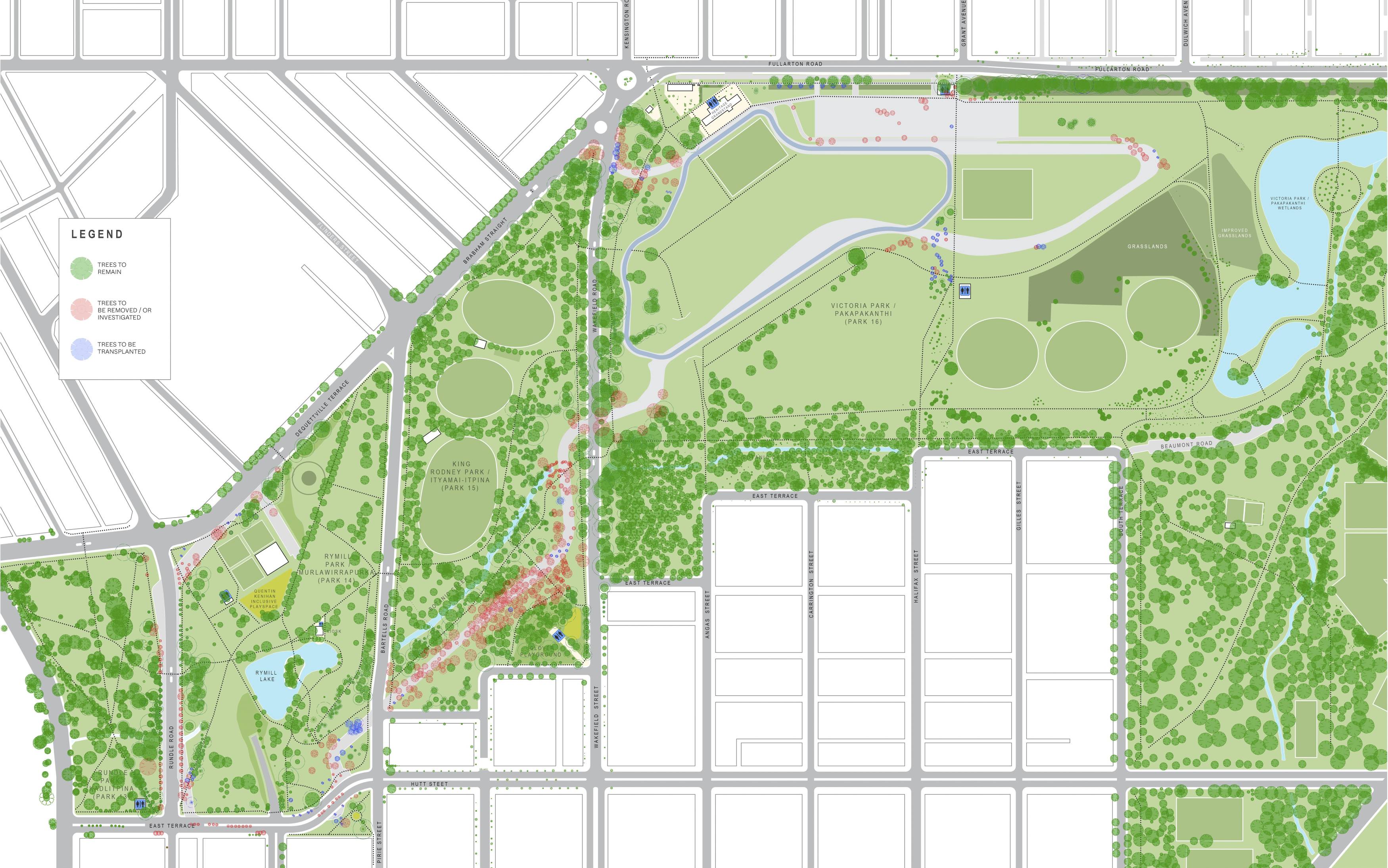
Map showing which trees in the circuit precinct are proposed to remain, be transplanted, or be removed or investigated.
Grasslands biodiversity
The native grasslands in Victoria Park/Pakapakanthi (Park 16) and habitat for the Chequered Copper butterfly have been a consideration in the circuit design process.
The grasslands conservation zone is relatively new. It has been improved through recent conservation work.
To meet circuit safety requirements, some of the existing native grassland conservation area within Key Biodiversity Area 1 will be affected.
The affected grassland area will be fully replaced, and the biodiversity area will also be expanded by a further 180m2. This means there will be more native grassland habitat overall.
We are also exploring opportunities to transplant native grasses into the new area.
We will work with the City of Adelaide and environmental groups to also improve the habitat quality, biodiversity values and ecological outcomes across the broader conservation area. This will support a stronger and more resilient habitat for the Chequered Copper butterfly.
Olive trees
The European olive was introduced to the Adelaide Park Lands in the mid-1800s as a source of commercial oil. Today, there are more than 1,600 olive trees across the Adelaide Park Lands, according to the City of Adelaide.
While the heritage-listed olive groves in North Adelaide are an important part of South Australia's history, the olive trees in King Rodney Park/Ityamai-itpina (Park 15) are not heritage-listed.
By moving the circuit away from Wakefield Road, the updated design affects some olive trees in King Rodney Park/Ityamai-itpina (Park 15) but, importantly, protects most of the significant native trees along Wakefield Road. As a result, more than 20 significant trees will be saved.
Managing tree and vegetation removals
Where impacts cannot be avoided, we will take all reasonable care when removing trees and vegetation.
Before any clearance works, trees and vegetation will be inspected for native fauna and habitat features. Where fauna is identified, appropriate measures will be taken, including:
- habitat protection, where practical
- staged or supervised clearance
- fauna relocation by specialists, where needed.
Large limbs, trunks and other material from native trees that need to be removed will be retained and repurposed, where possible. This material can continue to provide value in the Adelaide Park Lands through habitat creation, landscaping, nature play and public art opportunities. We will work with the City of Adelaide and other stakeholders to explore the best ways to achieve this.
Measures will also be taken to protect retained trees and vegetation throughout construction. These measures will be developed with advice from specialist arborists.