
Annual report 2025–2026
Our 2025–2026 annual report is on this page. The information is correct as at 30 September 2026.
You can also download the print version: Department for Infrastructure and Transport 2025–2026 Annual Report (PDF, 12.9 MB).
The print version contains:
- Appendix 1: Audited financial statements
- Appendix 2: Contractors engaged by the agency.
Submission
To:
The Hon Joe Szakacs MP
Minister for Infrastructure and Transport
The Hon Michael Brown MP
Minister for Police
This annual report will be presented to Parliament to meet the statutory reporting requirements of the Public Sector Act 2009, the Public Finance and Audit Act 1987, and other relevant Acts and the requirements of Premier and Cabinet Circular PC013 Annual Reporting.
Incorporated in this document is annual reporting by the Commissioner of Highways under the provision of the Highways Act 1926, and by the Rail Commissioner under the provision of the Rail Commissioner Act 2009.
This report is verified to be accurate for the purposes of annual reporting to the Parliament of South Australia.
Submitted on behalf of the Department for Infrastructure and Transport by:
Jon Whelan
Chief Executive
Date: 30 September 2026
From the Chief Executive
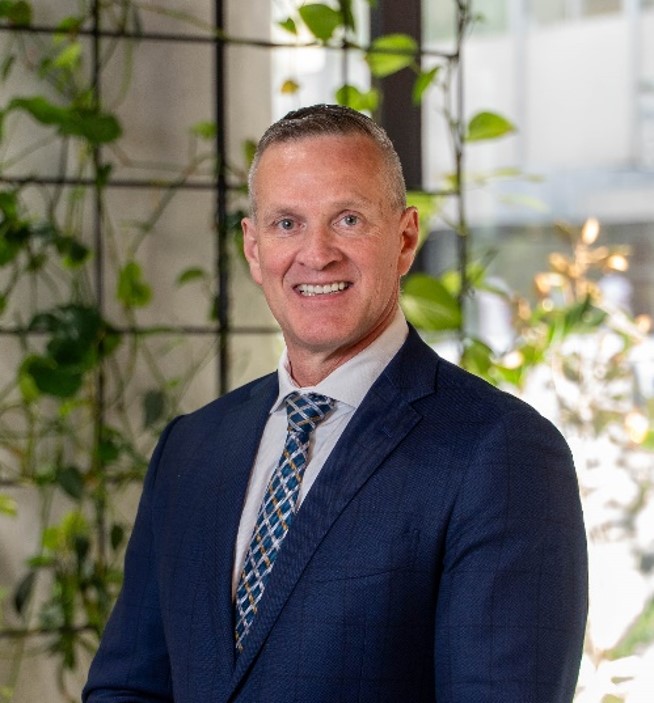
The Department for Infrastructure and Transport delivered a string of successful projects, programs and initiatives across South Australia during 2025-2026.
We continued to make major advancements on important infrastructure projects, including the River Torrens to Darlington Project and the Tram Grade Separation Projects, while responding to challenges such as outback flooding and delivering quality services in areas ranging from public transport to licensing and registration.
The $15.4 billion River Torrens to Darlington Project took further impressive steps forward this year.
Just 18 months after signing a contract to purchase Tunnel Boring Machines (TBMs), all components for the three large 15 metre diameter TBMs arrived in South Australia from October 2025, to March 2026, ready for assembly.
The assembly of the TBMs and other preparations for tunnelling at the numerous construction precincts along the project alignment, were major milestones for the project during 2025-2026.
This was a testament to the diligent efforts of the many people involved, both within the Department and our T2D Alliance.
The $15.4 billion T2D Project is the final 10.5-kilometre link in Adelaide’s North‑South Corridor and will complete 78 kilometres of non-stop, traffic light-free motorway between Gawler and Old Noarlunga.
Two TBMs will launch from the Southern Precinct to construct the twin 4.5 kilometre Southern Tunnels, while the twin 2.2 kilometre Northern Tunnels will be constructed using a third TBM.
Each of these TBMs has been named after women, in line with long-held international mining traditions.
Our machines were named after suffragists Mary Lee, Catherine Helen Spence and Elizabeth Webb Nicholls, trailblazing women who helped drive the campaign that would see South Australia become the first place in the world to grant women both the right to vote and the right to stand for Parliament.
All three TBMs will be operating in the 2026-2027 financial year and the tunnelling will take up to 24 months.
As part of T2D, work also continued this year on an $850 million package of broader network upgrades to improve local traffic flow, safety and connectivity and to complement the main motorway both during construction and on completion.
This program of works includes upgrades to a number of important intersections and junctions, including at Grange Road, Holbrooks Road and East Avenue; James Congdon Drive and Sir Donald Bradman Drive upgrade was completed; and major construction commenced on the Raglan Avenue, Edward Street and South Road upgrade.
During 2025-2026, the Department also completed major milestones on the $870 million Tram Grade Separation Projects.
Three congested Glenelg tram line level crossings were removed at Marion Road and Cross Road, Plympton and Morphett Road, Morphettville.
For those who have previously suffered long, frustrating delays at these crossings, this has been a major gain.
These level crossings, which previously could see boom gates down for up to 20 minutes per hour during peak times, were replaced by overpasses.
The existing South Road tram overpass at Glandore was also rebuilt to accommodate the T2D Project open motorway design.
This work required a nearly six-month closure of the tram line between South Terrace and Glenelg, with substitute buses running.
The tram line was fully reopened on 26 January 2026, in time for the start of the school year, as we promised.
Work has continued on the intersection upgrades, Shared Use Paths, community spaces and landscaping.
In another major improvement, motorists are now spending less time stuck in traffic, with faster and smoother travel to and from Adelaide Airport following completion of works on the Marion Road and Sir Donald Bradman Drive intersection.
The final section of the $810 million Fleurieu Connections Main South Road duplication was completed in February this year, improving safety, efficiency and accessibility for motorists travelling to McLaren Vale and the broader Fleurieu Peninsula.
The new jointly funded, $120 million Majors Road interchange was completed in October 2025, improving access to the Southern Expressway and reducing travel times, while also providing better connections to local sporting and recreational facilities.
Also south of the city, work began on three new overtaking lanes along Main South Road between Normanville and Cape Jervis to improve safety and traffic flow for locals, heavy vehicles and tourists, including those travelling to Cape Jervis to catch the ferry to Kangaroo Island.
The three overtaking lanes are part of a $111.8 million commitment jointly funded on a 50:50 basis by the South Australian and Australian governments.
In the Adelaide Hills, work continued on the $40 million upgrade of the Mount Barker roundabout at the intersection of Adelaide Road, Alexandrina Road, Wellington Road and Flaxley Road.
Works also commenced on the $150 million Adelaide Hills Interchange upgrades at Mount Barker and Verdun.
Once complete, the increased capacity of these new interchanges will help to reduce congestion, driver frustration and the risk of crashes, to better accommodate existing and projected growth in the rapidly expanding Mount Barker and Adelaide Hills area.
Also in the Adelaide Hills, the Amy Gillett Bikeway was extended from Mount Torrens through to Birdwood, in partnership with the Australian Government and Adelaide Hills Council.
A number of projects funded under the $150 million Adelaide Hills Productivity and Road Safety Package were completed, including safety upgrades on North East Road and Torrens Valley Road between Houghton and Gumeracha, to improve road safety and driveability, upgrades at the intersection of Junction Road and Jones Road in Balhannah, and a new single-lane roundabout at the intersection of Onkaparinga Valley Road, Nairne Road, and Junction Road in Balhannah.
In our outback regions, there was extensive work in 2025-2026, to respond to heavy rainfall and flooding that closed or damaged large parts of the sealed and unsealed road network and affected access for local communities.
Crews worked tirelessly to repair and safely reopen roads as quickly as possible. Due to the extent of the damage, some unsealed roads remain closed and repairs continue.
The response to flooding also included the introduction of a barge at Cooper Creek to support tourism, allow the movement of livestock, help secure the State’s beef supply and support local jobs in the meat processing industry.
The $27.4 million barge, jointly funded by the Australian and South Australian Governments under Disaster Recovery Funding Arrangements, allowed for safe crossings across the flooded Cooper Creek while road access was cut. While in operation, the barge carried 760 vehicles, including 330 heavy vehicles, 1,295 passengers and approximately 12,000 cattle.
Road maintenance and upgrades continued across the regions, including approximately $25 million of work on the Southern Ports Highway in the State’s southeast, boosting freight efficiency and making travel safer on the key tourist route.
The State Government also welcomed $9.9 million in funding from the Australian Government’s 2025-2026 Black Spot Program to upgrade 20 locations across the State, improving safety for road users.
In January 2026, we were delighted to complete the new $135 million Adelaide Aquatic Centre.
The opening generated a huge amount of community interest and support, with more than 10,000 people registering in a ballot to be among the first to enjoy the new Aquatic Centre’s indoor and outdoor pool areas, four water slides, splash zones, diving amenities, sauna and steam rooms, café and retail spaces, and lawned recreation areas.
Not only did the project deliver a world-class facility, but it also returned more than 1,000 square metres of Park Lands to the community.
The State Government’s more than $70 million upgrade of the ports at Cape Jervis and Penneshaw was also completed.
On Eyre Peninsula, the Streaky Bay Jetty was opened following $9.7 million of restoration works to future-proof the historic structure.
The State Government also offered support to the rock lobster industry in the South East, with a $3.5 million upgrade of the Southend Jetty underway.
Our contribution to the Northern Water Project advanced significantly this year, including the confirmation of Mullaquana Station as the site of the proposed desalination plant.
The Request for Proposal tender process for the Northern Water design, build, operate and maintain contract commenced and extensive site investigations and development of a reference design for the project were completed.
Project development continued through investigations and assessments, procurement and commercial processes, negotiation of Indigenous Land Use Agreements and ongoing stakeholder and community engagement.
Adelaide Metro continued to deliver high-quality public transport, including the significant achievement of welcoming tram operations back into public hands in August 2025.
This major achievement built on the return of train operations in February 2025, and ensures that all revenue is reinvested into a safer and more reliable public transport system.
Cheaper public transport was also introduced for school students this year with the $10, 28-day MetroCARD, an initiative that has been embraced by South Australian families. This means students can now catch public transport for the equivalent of as little as 25 cents a trip.
This has made public transport an even more attractive and convenient option for students and has provided welcome cost-of-living relief to family budgets.
South Australian Seniors Card members continued to travel for free on Adelaide Metro buses, trains and trams all day, every day. Since July 2022, Seniors Card holders have saved around $44 million.
During 2025-2026, free public transport was again offered to many major events in the city, encouraging people to leave their cars at home.
This included AFL matches, the Gather Round footy festival, the Royal Adelaide Show, the Christmas Pageant, New Year’s Eve celebrations, the Ashes Test and LIV Golf, to name just a few.
Travelling by bus and train was also made easier with the introduction of an updated app that includes expanded ticketing options and the availability of tap and go payments on trains.
Adelaide's public transport bus fleet received a further environmental and efficiency boost this year with the introduction of 60 new electric buses onto the road network.
The Department has also continued to deliver quality support, safety initiatives and regulation to the State’s many boaties.
As well as spot compliance inspections, the team delivered safety advice to boaties at local boat ramps and at larger events, including South East Field Days.
Service SA continued to provide quality services across the State, both online and in person at service centres. It has been a busy year for Service SA, which played an important role in supporting government initiatives such as drought relief, registration rebates and algal bloom related discounts on registration fees.
During the year, the Service SA Modbury Centre opened in its new location in Modbury Triangle Shopping Centre. The new centre is a modern site with improved access and a stronger focus on digital self-service.
Service SA’s Saturday trading continued at five key sites and has now reached a major milestone, with South Australians making more than 150,000 Saturday visits to Service SA centres over the past three years.
The Department has also continued to advance its Reconciliation Action Plan, which includes our commitment to Closing the Gap targets and comprehensive training for all staff.
We have more Aboriginal staff in leadership roles across the Department, which is part of our commitment to recruiting and retaining Aboriginal employees.
In recognition of National Reconciliation Week and NAIDOC week, we were also proud to have one of our trams displaying artworks by Aboriginal artists Presten Warren, Violet Buckskin and Jaylene Ware.
The projects our Department delivers have an impact on the lives of people in the community and we have continued to consult and engage with the public to gather feedback and keep people informed about works and their progress.
Throughout the year, our community engagement team directly engaged with more than 14,500 South Australians across the State. This included distributing almost 400 project notifications and hosting 162 community events across 61 locations.
In a changing communication environment, we have also increasingly used social media to effectively connect with people in their daily lives. Across our social media platforms, we now have more than 230,000 followers, meaning this is a very powerful tool to provide project and service information to our communities and customers.
The work we have delivered continues to meet the highest standards, and I thank each member of our team for their professionalism, dedication and hard work.
There is still a vast pipeline of works ahead of us, and I look forward to seeing it delivered.
Jon Whelan
Chief Executive
Department for Infrastructure and Transport
Overview: about the agency
Our strategic focus
| Our Purpose | We connect South Australians to keep our State moving – now and for the future. |
|---|---|
| Our Vision | Every South Australian can easily access the services they want, the transport they rely on and the infrastructure they need. |
| Our Values | Collaboration, Honesty, Excellence, Enjoyment, Respect, Safety. |
Our functions, objectives and deliverables
Transport Strategy and Planning
Shapes South Australia’s transport future through transport strategies, infrastructure projects and investment programs enabling State prosperity, sustainability and connectivity.
The Division is focused on delivering:
- Transport strategies and plans.
- An investment pipeline with transport infrastructure project plans and designs.
- Data, technical and customer insights to better inform transport services.
- Strong governance and oversight of transport investment programs and infrastructure projects.
Infrastructure Delivery
Delivers and integrates social and transport infrastructure safely and efficiently to sustain and support growth and maximise the benefit of government’s investments.
The division is focused on delivering:
- Fit-for-purpose social and transport infrastructure that is responsive, meets customer needs and generates economic and community-orientated benefits and outcomes.
- Whole of lifecycle solutions developed and delivered collaboratively with colleagues, industry and key stakeholders.
- Leading practice and innovation in safety, environmental management, sustainability, procurement, design, engineering, and delivery.
- Effective governance and project controls to ensure Departmental compliance with relevant legislation, standards, the Code of Ethics and policies as well as on‑time and on‑budget delivery.
North-South Corridor Program Delivery Office
Develops the plans and oversees the delivery of infrastructure needed to complete the final 10.5 kilometre section of the North-South Corridor, the River Torrens to Darlington Project, which will deliver a non-stop South Road. The division is focused on delivering a project that:
- Significantly contributes to economic development.
- Improves liveability, connectivity and facilitates job growth.
- Delivers travel time savings and boosts productivity.
- Improves road safety.
Road and Marine Services
Connects our communities by enabling safe, reliable and efficient movement and flow of goods, services and people across the State’s road and marine networks. The division is focused on delivering:
- Safe and reliable road and marine infrastructure that is operated and maintained to maximise economic and community benefit.
- Optimised networks, with data-driven solutions, that optimise overall performance in the movement of goods, services, and people.
- Forward-thinking policies, strategies and programs based on stakeholder engagement and evidence that will enable safe, inclusive, productive, efficient, sustainable transport.
- Service delivery that meets customer needs and expectations.
Public Transport South Australia
Delivers customer-focused public transport and better maintained State assets in partnership with our service providers, delivering:
- Integrated end-to-end journeys with easier access, and information, payments and navigation enabled by new technologies.
- A clear plan for growth that makes the case for investment in new public transport assets and transitions them into service efficiently.
- Initiatives that support the Government’s goal to achieve net zero emissions by 2050.
- Better public transport networks that attract more customers.
- Improved customer experience through simple, safe and easy-to-use public transport services to attract and retain customers.
- Continued improvement of public transport assets that enhance accessibility, safety and security.
- High-quality train services through effective, efficient, and safe operational practices that prioritise on-time performance, customer satisfaction, and the reliability of the network.
- Maintain a high level of customer service by ensuring all frontline staff are visible, well informed and responsive, creating a welcoming and supportive environment for all passengers, while actively managing disruptions and keeping service reliability as high as possible.
Transport Policy and Regulation
Connects our communities by delivering policy initiatives, community information and provision of services for safe road use and travel behaviour, while overseeing regulatory, road safety and policy responsibilities and delivering customer‑focused services through Service SA:
- Forward-thinking policies, strategies and programs based on stakeholder engagement and evidence that will enable safe, inclusive, productive, and sustainable road use and travel behaviour.
- Effective regulation of access and usage that assures safety and sustainability, with clear boundaries reflecting reasonable expectations.
- Service delivery that meets customer needs and expectations.
Commercial and Contract Management
Responsible for the procurement of civil construction projects, contract management and commercial advisory services for these projects and the Department’s road maintenance contracts, to ensure delivery is undertaken in accordance with contractual requirements. The division is focused on:
- Procuring civil infrastructure and maintenance projects.
- Ensuring contractors perform contracted works in accordance with the terms of their contracts.
- Protecting the public interest in the delivery of infrastructure and maintenance projects by holding contractors to account to ensure that works are delivered within budget.
- Delivering contract management services that serve as a model for contract management throughout government.
- Maintaining effective procurement governance and contract management controls.
Public Affairs
Listens to, informs, communicates and collaborates with customers, staff and stakeholders to improve outcomes for our communities, economy and State. The division is focused on delivering:
- Social value by putting people at the centre of everything we do, ensuring we deliver better outcomes for customers, stakeholders and the community.
- Trusted advice and services to government, supporting our business partners to ensure goals are achieved.
- Accurate, transparent and timely communications, with a focus on building our social licence and enhancing the Department’s reputation.
- A positive organisational culture that promotes the Department as a workplace of choice.
People and Corporate Services
Provides systems and assurance processes for managing our people, our finances, our performance and risk, ensuring we can work safely, efficiently, and productively. The division is focused on delivering:
- A high-performing organisation that is enabled by well-designed systems, processes, and technology, with effective management frameworks that enable efficient work practices.
- Effective control frameworks that ensure ongoing compliance with all relevant legislative, regulatory and policy requirements.
- Valuable advice and user‑orientated services that support business partners enabling them to deliver an engaging work environment with a clear focus on safety, flexibility, productivity and progressive practices.
- A skilled, motivated and diverse workforce demonstrating our values in their actions.
Office of the Chief Executive
The Office of the Chief Executive is responsible for the delivery of a comprehensive range of professional, strategic and responsive executive support services to the Chief Executive and the Executive team, with a strong focus on driving strategic priorities and objectives for the Department and government.
The Office of the Chief Executive provides a key customer service and interface with Ministerial Offices, to ensure the provision of accurate and timely information.
Northern Water Project Delivery Office
Oversees the pre-delivery and procurement phases of the Northern Water Project, which aims to deliver a large-scale desalination plant in the Upper Spencer Gulf to support industrial growth and reduce reliance on unsustainable water sources. The division is dedicated to the successful delivery of the pre-delivery and procurement phase of the project, with a focus on:
- Conducting a robust procurement process for the Northern Water Project Design, Build, Operate and Maintain Contract.
- Obtaining the necessary primary approvals for the project.
- Managing site investigations and integration works.
- Securing land required for project delivery.
Our organisational structure
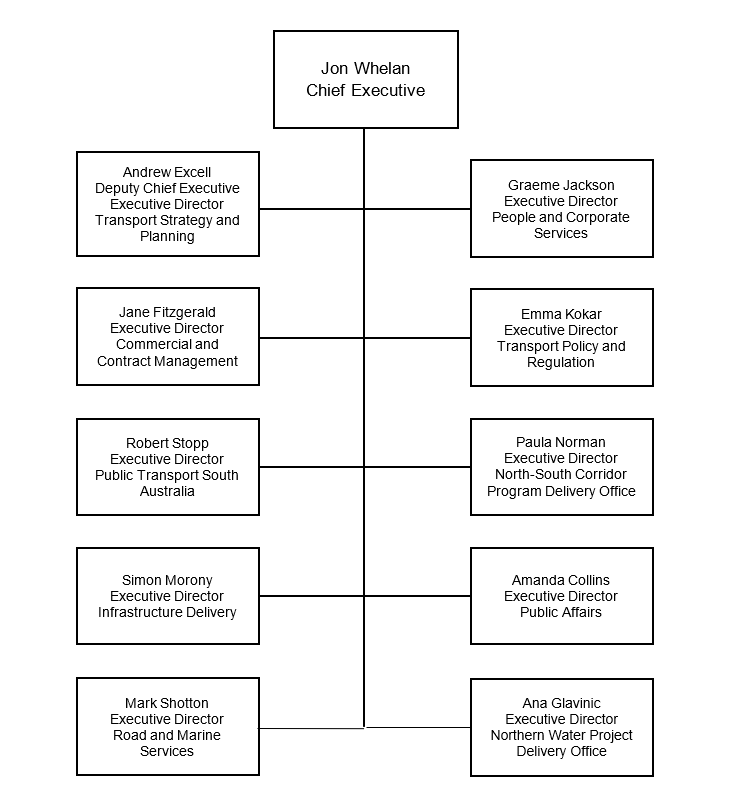
As at 30 June 2026, the Department’s Executive Leadership Team comprised:
Changes to the agency
During 2025-2026, there were no changes to the agency’s structure and objectives as a result of internal reviews or machinery of government changes.
Our Ministers
 | The Hon Joe Szakacs MP is the Minister for Infrastructure and Transport. Minister Szakacs oversees infrastructure planning and provision, and the development of transport systems and services, to deliver improved connectivity and social and economic benefits to the State. |
 | The Hon Michael Brown MP is the Minister for Police, Minister for Correctional Services, and the Minister for Consumer and Business Affairs. The Minister for Police oversees road safety initiatives to improve road user safety outcomes in South Australia. |
Legislation administered by the agency
Adelaide Oval Redevelopment and Management Act 2011
Adelaide Railway Station Development Act 1984
Aerodrome Fees Act 1998
Air Navigation Act 1937
Air Transport (Route Licensing—Passenger Services) Act 2002
Alice Springs to Darwin Railway Act 1997
AustralAsia Railway (Third Party Access) Act 1999
Civil Aviation (Carriers' Liability) Act 1962
Commissioner of Public Works Incorporation Act 1917
General Tramways Act 1884
Golden Grove (Indenture Ratification) Act 1984
Government House Precinct Land Dedication Act 2016
Harbors and Navigation Act 1993
Heavy Vehicle National Law (South Australia) Act 2013
Highways Act 1926
Land Acquisition Act 1969
Marine Safety (Domestic Commercial Vessel) National Law (Application) Act 2013
Maritime Services (Access) Act 2000
Metropolitan Adelaide Road Widening Plan Act 1972
Mile End Underpass Act 2005
Mobil Lubricating Oil Refinery (Indenture) Act 1976
*Morphett Street Bridge Act 1964
Motor Vehicles Act 1959
National Soldiers Memorial Act 1949
Non-Metropolitan Railways (Transfer) Act 1997
North Haven Development Act 1972
North Haven (Miscellaneous Provisions) Act 1986
Oil Refinery (Hundred of Noarlunga) Indenture Act 1958
Passenger Transport Act 1994
Proof of Sunrise and Sunset Act 1923
Protection of Marine Waters (Prevention of Pollution from Ships) Act 1987
Public Employees Housing Act 1987
Rail Commissioner Act 2009
Rail Safety National Law (South Australia) Act 2012
Rail Transport Facilitation Fund Act 2001
Railways (Operations and Access) Act 1997
Railways (Transfer Agreement) Act 1975
Road Traffic Act 1961
South Australian Ports (Bulk Handling Facilities) Act 1996
South Australian Ports (Disposal of Maritime Assets) Act 2000
*Steamtown Peterborough (Vesting of Property) Act 1986
*Tarcoola to Alice Springs Railway Agreement Act 1974
Terrorism (Surface Transport Security) Act 2011
Victoria Square Act 2005
Waite Trust (Vesting of Land) Act 2020
West Lakes Development Act 1969
*Denotes Act of limited application
The agency's performance
Performance at a glance
During 2025-2026, the Department achieved the following:
- Continued major construction works on the River Torrens to Darlington (T2D) Project.
- Delivered and assembled the three large Tunnel Boring Machines that will undertake the tunnelling component of the T2D Project, with all three expected to be operating in the second half of 2026.
- Constructed the South Road and Morphett Road tram overpass to accommodate the new open motorway section of the T2D Project.
- Progressed delivery of the Broader Network Upgrades to support the T2D Project, including upgrading a number of key intersections.
- Completed construction of the new world-class Adelaide Aquatic Centre Development, which opened in January 2026.
- Completed delivery of the Limestone Coast Technical College, Port Augusta Technical College and Mount Gambier Technical College.
- Commenced works for the new Northern Suburbs High School in early 2026.
- Continued works on the Flinders Medical Centre redevelopment and the new Mount Barker Hospital.
- Completed regional hospital upgrades and new works at the Port Pirie Regional Health Emergency Department Redevelopment, Bordertown Memorial Hospital Country Health Connect Upgrade and Mount Gambier Hospital Upgrade - Emergency Department.
- Completed the APY Lands Police Facilities and Umuwa Multi-Agency Facility.
- Completed construction on the new South Australian Ambulance Service Precinct at Mile End South, which provides an Emergency Operations Centre and State Health Control Centre.
- Completed new or upgraded SAAS Ambulance Stations at Golden Grove, Gawler, Wallaroo, Campbelltown and Goolwa.
- Completed major milestone works on the Tram Grade Separation Projects, including building three new overpasses and removing three heavily congested level crossings.
- Completed construction of the Marion Road and Sir Donald Bradman Drive Intersection Upgrade.
- Completed critical maintenance works and refurbishment of key structural elements of the Port Bonython Jetty.
- Completed works for the Kangaroo Island Ports Upgrade.
- Completed the Majors Road Interchange on-off ramps on the Southern Expressway.
- Completed Stage Two of the Main South Road Duplication Project, from Aldinga to Sellicks Beach, as part of the Fleurieu Connections projects.
- Completed works on regional road networks, including the Augusta Highway, intersection upgrades along the Barrier Highway Corridor, Spencer Highway, Southern Ports Highway, from Robe to Clay Wells Road, and Stuart Highway.
- Introduced a framework to regulate the use of personal mobility devices on the road network, delivered an associated community education campaign and commenced a review of these e-scooter and e-bike laws.
- Assisted customers through the Drought Relief Primary Producer vehicle registration rebate scheme.
- Progressed implementation of the Driver Training Reforms.
- Progressed the implementation of the Passenger Transport Act Review, including the buyback of taxi licences through the Taxi Industry Reform Package.
- Opened a new Service SA Centre at Modbury.
- Increased annual subsidised trip allocation under the South Australian Transport Subsidy Scheme.
- Expanded heavy vehicle network access for more efficient truck and trailer configurations, providing increased operational flexibility
- Introduced changes to the disability parking permit scheme to better reflect the diversity of South Australians with disabilities.
- Continued delivery of the Way2Go program.
- Continued the On the Right Track Program, including marking the 10-year anniversary of this successful program.
- Commenced implementation of school-time-based 40 km/h speed limits.
- Introduced mandated multi-factor authentication for mySAGOV accounts.
- Established the new Road Safety Governance Committee, bringing together government and non-government experts.
- Worked closely with the State and Federal Fuel Taskforces and external stakeholders in response to the fuel crisis.
- Partnered with Iwiri Aboriginal Corporation to deliver culturally appropriate training for frontline security workers and staff at the Adelaide Railway Station.
- Provided emergency response support for a range of incidents, including the Deep Creek fires and the Far North flooding.
- Transitioned tram operations back to Government in accordance with the March 2022, State Election commitment.
- Extended bus services and constructed six new bus stops to improve services for residents in the Riverlea development.
- Implemented an improved Gawler line timetable.
- Introduced the first fleet of 60 battery electric buses into the network.
- Undertook planning and technical assessment to support AUKUS; Northern Water, Adelaide Circuit Redevelopment, South Australian Forensic Centre, South Australian Sports Institute Redevelopment and other projects.
- Undertook planning for the removal of the Curtis Road level crossing, metropolitan and regional rail extensions, the Adelaide Northern Growth Areas Program, the High Productivity Vehicle Network, the River Murray Transport Network Resilience Program and the Level Crossing Removal Program.
- Released the Forward Work Plan: Major Programs 2025-2028.
- Transitioned the successful Mount Barker On Demand service trial into the existing Hills Metropolitan Bus Services Contract.
- Added regional public transport information to the Adelaide Metro website, making regional bus routes available online.
- Installed new barrier gates at the Adelaide Railway Station, enabling Tap and Pay and Buy & Go for train customers.
- Installed and commissioned 60 permanent bus charging units at the Morphettville bus depot to support the transition to an electric bus fleet.
- Launched the Deckee boating app for public use.
- Successfully negotiated a variation to the new Kangaroo Island Ferry Service Deed to reduce livestock freight rates for vehicles over 6 metres from 1.5 to 1.2 times the base rate.
- Constructed and operated the Cooper Creek Barge, restoring connectivity for flood-affected communities and properties.
- Confirmed Mullaquana Station as the preferred site for the proposed desalination Northern Water Project desalination plant.
- Progressed the Request for Proposal tender process for the Northern Water Design, Build, Operate and Maintain contract.
Agency specific objectives and performance
The Department is committed to the continued delivery of a multi-billion-dollar pipeline of infrastructure investment, while implementing key reforms, supporting the continued growth of the South Australian economy and the social wellbeing of our communities.
| Agency objectives | Indicators | Performance |
|---|---|---|
Effective Planning Policy | Infrastructure Planning | Made significant progress implementing South Australia's Transport Strategy. Supported significant State development projects, including AUKUS; Northern Water; the South Australian Forensic Centre; South Australian Sports Institute Redevelopment; and other major developments. Undertook planning for major Australian and State Government-funded initiatives, including the removal of the Curtis Road Level Crossing; metropolitan and regional rail extensions; the Adelaide Northern Growth Areas Program; the High Productivity Vehicle Network; the River Murray Transport Network Resilience Program; and the Level Crossing Removal Program. Commenced transport planning studies for the Limestone Coast, Adelaide Metropolitan and Murray Mallee regions to inform future investment priorities and support integrated transport and land use planning. Completed a new Transport Strategy and commenced work on the Active Transport Strategy to support greater travel choice and increased participation in walking and cycling. Progressed road safety improvements through the Regional Road Safety Infrastructure Program, the National Black Spot Program and the Safer Local Roads and Infrastructure Program. Assessed South Australia's regional road network to evaluate star rating improvements and included the results on the National AusRAP Dashboard. Progressed towards a net zero transport system through the completion of a Carbon Management Plan to reduce the Department’s operational emissions. Commenced planning to minimise emissions from construction and maintenance activities. Updated the Transport Planning Master Specifications and Sustainability Manual; prepared the draft Sustainable Government Building Requirements; and completed a Departmental Climate Risk Audit. Continued transport modelling and analytics, and enhanced data capabilities to support investment and policy decisions. This included a major upgrade of the Road and Railside Significant Sites database to improve access to environmental and heritage information. Continued governance and assurance arrangements to support the effective delivery of transport infrastructure projects and programs across the State. Released the Forward Work Plan: Major Programs 2025-2028, outlining road, rail, marine, public transport, active travel, planning and community projects across regional and metropolitan South Australia. Progressed an amendment bill to the Harbors and Navigation Act 1993, to introduce the ability for the Minister to publish harbor rules, safety directions and other miscellaneous changes. |
Efficient Transport Services | Customer Focused Services | Completed major works on the Tram Grade Separation Projects including level crossing removals on Marion Road, Cross Road and Morphett Road, and modifications to the South Road tram overpass. Testing and commissioning were completed and tram services resumed in January 2026, in time for the return of school. Completed the Bicycle and Pedestrian Actuated Crossing on Kings Road, Salisbury Downs and the Levels-City Bikeway. Introduced changes to the disability parking permit scheme to better reflect the diversity of South Australians with disabilities. Increased the number of trips allowed under the South Australian Transport Subsidy Scheme. Drought Relief ended on 31 December 2025, with 280 approved for payment and $520 000 paid in rebates. Developed the new online training module, Your Safe Vehicle and integrated it into MyL’s. Implemented measures associated with the algal bloom response, including a 50% discount on recreational boat and light boat trailer registration for 12 months. Implemented digital refunds for registration and driver licensing transactions. Conducted Round 4 of the South Australian Car Club Program, which provides grants to local car and motorbike clubs. Opened a new Service SA Centre at Modbury, providing a larger, more accessible site. Continued the Way2Go program, which promotes safer, greener and more active travel for primary school students and their communities. Continued the On the Right Track Program that supports Aboriginal and Torres Strait Islander people in remote locations to obtain a driver’s licence. Introduced a framework to enable consideration of exemptions for organisations with paid driver supervision services from holding a Motor Driving Instructor licence. Introduced mandated multi-factor authentication for mySAGOV accounts. Coordinated 151 responses to Freedom of Information requests. Reduced the travel time of approximately 75% of services of services on the Gawler rail line by two minutes. Feeder bus services were amended to maintain connections between modes. Extended bus services to improve public transport for Riverlea residents. Six new bus stops were constructed as part of the expansion. Formally transitioned the Mount Barker On Demand service - including six new electric buses and associated charging infrastructure - into the existing Hills Metropolitan Bus Services Contract from 1 December 2025. Completed a review of regional public transport services to deliver an election commitment to enhance public transport services for people living in regional South Australia. Added regional public transport information to the Adelaide Metro website to make regional bus routes available online. Undertook dredging at Penneshaw Harbour to accommodate the new SeaLink ferries. Successfully negotiated a variation to the new Kangaroo Island Ferry Service Deed to reduce the livestock freight rate for vehicles over 6 metres from 1.5 to 1.2 times the base freight rate when the new ferry service commences. |
Valuable Social and Economic Infrastructure | Customer Focused Services | Provided public transport support to the Wheelchair Rugby World Challenge and National Championship. Provided better access to food relief services, with buses stopping at the Foodbank Hub in Mount Gambier. Returned tram services to government hands in August 2025. Finalised a competitive two-phase procurement process for the 19 regional bus services contracts in late 2024. Phase 2 included four of the remaining five contracts, which commenced on 1 November 2024. Rolled out smart ticketing across the Adelaide Metro network, including commissioning new ticketing gates at Adelaide Railway Station. Installed external smart validators for the Tea Tree Plaza car park boom gate, enabling customers to use their Tap and Pay (EMV) ticket to exit the car park. Undertook a River Murray Flood Recovery Assessment. Completed the upgrade of the Marion Bay Boat Ramp. Refurbished three promenades at the Lincoln Cove Marina. Mid Murray Council accepted a Marine Facilities Fund grant of $2.9 million to upgrade the Swan Reach Boat Ramp. The District Council of Loxton Waikerie accepted a Marine Facilities Fund grant of $302 720 to upgrade the Paisley Boat Ramp. Renmark Paringa Council accepted a Marine Facilities Fund grant of $506 000 to upgrade the Bert Dix Park Boat Ramp. Completed VHF Emergency Radio monitoring equipment upgrades. Introduced half‑price vessel registration from 1 December 2025, to 1 December 2026, as part of the South Australian Government’s Algal Bloom Summer Plan. Delivered free use of boat ramps along the South Australian coast and provided grants to local governments for 12 months to support the State's response to the South Australian Algal Bloom. Delivered repair works to flood-damaged roads to improve resilience and connectivity for remote communities. Supported major tourist attraction events, including the Tour Down Under, by ensuring the safety and quality of the road network for participants. Constructed and operated the Cooper Creek Barge to restore connectivity for flood-affected communities and properties. |
Valuable Social and Economic Infrastructure | Enhancement of current transport infrastructure | Completed critical maintenance works and refurbishment of key structural elements of the Port Bonython Jetty to extend operational lifespan by years. Completed works for the Kangaroo Island Ports Upgrade project (works at Cape Jervis and Penneshaw). Installed 17 bus shelters as part of an upgrade program across metropolitan Adelaide. Installed Auxiliary Power Units for the Flexity trams to convert the overhead power supply to usable power for air conditioning, lighting and passenger information systems. Commenced replacement of tram CCTV and Passenger Information Systems. Installed Tactile Ground Surface Indicators for people with vision impairment at East Grange, Cheltenham, Draper, Taperoo, North Haven and Greenfields railway stations. Undertook community engagement on the Rosewater Loop, including greening and planting activities. Continued restoration of the State Heritage-listed Alberton Railway Station. Opened the new interchange and dual carriageway from Aldinga to Sellicks Beach to traffic as part of the Main South Road Duplication Stage 2 works. Opened the new South Road Tram Overpass Shared Use Path. Commenced work on Main South Road overtaking lanes between Normanville and Cape Jervis. Continued to deliver various programs of work to resurface and rehabilitate inner urban roads and reseal and rehabilitate rural roads. Completed approximately 15,800 kilometres of maintenance, rain damage and emergency response grading on unsealed roads across the outback road network. Delivered targeted safety improvements across the road network through the $5 million Road Safety Maintenance Program, including safety barrier and lighting infrastructure renewals, traffic controller replacements, shoulder re‑sheeting and sealing works on St Vincent Highway, and skid management treatments to improve road safety and network resilience. |
Valuable Social and Economic Infrastructure | Progress of Major Transport and Social Infrastructure Projects, Programs, and Planning Studies | The T2D Project achieved several major milestones, including the delivery and assembly of three TBMs. Continued works on the South Road and Morphett Road tram overpass. Commenced production of tunnel-lining segments and road deck units, supporting the next phase of T2D tunnel construction. Continued delivery of the $850 million Broader Network Upgrades as part of the T2D Project with key upgrades completed, including the intersection of Sir Donald Bradman Drive and James Congdon Drive. Completed other early and enabling T2D works, including major utility relocations and the construction of a substation at Richmond East. Completed the new Adelaide Aquatic Centre, which was opened in January 2026. Completed new technical colleges at Port Augusta, Mount Gambier and the Limestone Coast. Commenced construction on the new Northern Suburbs High School. Completed Seaview Downs and Pimpala primary schools. Completed construction of various South Australia Police facilities to accommodate functions relocating from the existing Thebarton Barracks. Completed regional hospital upgrades, including the Port Pirie Regional Health Service Emergency Department Redevelopment, the Bordertown Memorial Hospital Country Health Connect Upgrade and the Mount Gambier Hospital Emergency Department Upgrade. Completed the new Psychiatric Intensive Care Unit beds at the Flinders Medical Centre - Margaret Tobin Mental Health Centre. Completed the Noarlunga Hospital Inpatient Expansion and Mental Health Unit and the Modbury Hospital - Older Persons' Mental Health Facility Project. Completed work on South Australian Ambulance Service stations, including new and upgraded stations at Golden Grove, Gawler, Wallaroo, Campbelltown and Goolwa. Completed work on the South Australian Ambulance Service Precinct at Mile End South, which will provide an Emergency Operations Centre and State Health Control Centre. Continued construction on the 312-bed expansion of Yatala Labour Prison. Commenced construction on the new Netball SA Stadium Redevelopment. Completed works on Eyre Peninsula roads - Overtaking Lanes - Lincoln Highway, Flinders Highway, Tod Highway and Western Approach Road. Completed construction of the Majors Road Interchange on the Southern Expressway. Completed major works on the Main South Road Stage 2 (Aldinga to Sellicks Beach) as part of the Fleurieu Connections package. Completed works on the Birdwood to Verdun Corridor, Mount Pleasant Corridor, North East Road and Torrens Valley Road as part of the $150 million Adelaide Hills Productivity and Road Safety Package. Completed works on the Marion Road and Sir Donald Bradman Drive Intersection Upgrade. Continued works on the $215 million upgrade of the Strzelecki Track, which includes rehabilitation works and sealing along sections of the 472 kilometre track. Completed works on regional road networks and various regional highways such as Barrier Highway, Spencer Highway and Southern Ports Highway. The Aboriginal Workforce Development Program, delivered by the Aboriginal Building & Civil Construction Academy, supported 15 apprentices during the Tram Grade Separation Projects, with seven achieving the 12-month milestone and continuing with host employers in the industry. Several others transitioned to alternative employment. Progressed key pre-delivery and procurement milestones for the Northern Water Project including:
|
Safe, Reliable and Efficient Movement | Speed / Safety Management Initiatives | Completed works to deliver a new heavy vehicle rest area at Salt Creek along the Princes Highway. Commenced delivery of 40 km/h time‑based school speed limits on roads near schools with existing speed limits of 50 km/h or higher, with the rollout covering approximately 160 school sites across South Australia. Continued design works to upgrade the road between Crafers and Glen Osmond to a managed motorway as part of the South Eastern Freeway Upgrade. Continued the Way2Go program, which promotes safer, greener and more active travel for primary school students and their communities. Continued the On the Right Track Program, which provides assistance and support to Aboriginal and Torres Strait Islander people in remote locations to obtain a driver’s licence. Introduced a framework to regulate the use of personal mobility devices (including e-scooters) on the road network and commenced a review of Personal Mobility Devices (including e-scooters) and e-bikes. Delivered heavy vehicle access reforms under the Ministerial commitment to transition permits to notice. Established the Road Safety Governance Committee to provide advice and recommendations around road safety actions and measures that will contribute towards achieving our long-term vision of zero lives lost on our roads by 2050. Delivered a campaign focused on asking drivers, ‘Are they fit to drive?’. Delivered an education campaign related to buying safer vehicles. Delivered legislative and regulatory changes that made measurable contribution to road safety outcomes. Continued the program to install new protective bus driver security screens to 940 government‑owned buses. Installed defibrillators on all government-owned buses, private Adelaide Metro buses, regional contract buses and trains and trams. Delivered Pedestrian Activated Crossings on Springbank Road in Colonel Light Gardens and Panorama, and Grand Junction and Montrose Avenue in Clearview, providing key crossing points for vulnerable road users. Delivered four digital speed signs for mariners. Progressed the marine webcam expansion project, including 67 cameras for public use. Conducted 2,374 vessel inspections across the State, with 1,098 inspections resulting in enforcement action. Delivered 34 Stay Afloat lifejacket maintenance clinics. Upgraded boat ramp static signage at O’Sullivan Beach, West Beach, and North Haven. Replaced navigation aids at various locations along the metropolitan and Yorke Peninsula coastal areas. |
Safe, Reliable and Efficient Movement | Facilitate the safe and efficient management of road network activities. | Processed approximately 4,000 roadworks permit requests per month. Supported safe and compliant access for heavy vehicles across the road network with approximately 1,400 heavy vehicle access permits processed per month. |
| Closing the Gap Priority Reform 1: Partnerships and shared decision-making | Partnerships with Aboriginal community-controlled organisations developed | Increased the number of partnerships with Aboriginal Community Controlled Organisations (ACCOs) and delivered meaningful opportunities to partner with ACCOs. |
| Closing the Gap Priority Reform 2 Building the ACCO sector | Growth of meaningful consultations with Aboriginal communities across the State. | Undertook more than 95 direct engagements with Aboriginal organisations, involving 28 ACCOs across the State, and 22 Prescribed Body Corporates. |
Corporate performance summary
Throughout this financial year, the Department, through the People and Corporate Services Division, supported workforce performance, safety and capability development by designing and delivering programs and initiatives that strengthened workplace culture, enhanced the employee experience, promoted wellbeing, and fostered a safe, inclusive and high performing environment where our people can thrive.
Key achievements included implementing the Respect and Acceptable Behaviours in the Workplace Policy and commencing the development of a supporting online Respectful Behaviours training module. This work reinforced expectations for respectful conduct and promoted a positive workplace culture.
The Department further advanced its commitment to inclusion and belonging through the development and implementation of a Gender Affirmation Guideline, providing practical support to ensure a respectful and inclusive workplace for transgender and gender-diverse employees.
Work was also undertaken to strengthen organisational performance and development through enhancements to the Performance Management Framework, reinforcing the value of meaningful conversations between managers and employees about performance, capability development and career growth.
The Department maintained its focus on employee wellbeing by increasing the visibility of, professional development opportunities for, and support available through the Mental Health First Aid Officer Network, helping to foster a psychologically safe and healthy workplace.
Recognition of employee contributions remained a priority, with individuals and teams recognised through Departmental recognition programs and sector-wide awards, including the Public Sector Excellence Awards, SA Women of Impact Awards and the Governor’s Multicultural Awards.
The Department also strengthened its leadership in the prevention of domestic, family and sexual violence by maintaining White Ribbon accreditation, implementing the DV Safe Phone initiative, and formalising a partnership with the Zahra Foundation, supporting advocacy, awareness and prevention efforts across the workforce and community.
Building on the successful implementation of the Diversity, Equity and Inclusion Strategy and Action Plan 2024–2026, the Department developed a Neurodiversity at Work Strategy, Framework and Action Plan. This work built on strong employee engagement with the Office for Autism’s Autism Awareness Training and further strengthened the Department’s commitment to creating an accessible and inclusive workplace.
The Department also elevated the role of Communities of Practice and employee-led networks, recognising them as important mechanisms for raising awareness, collaboration and knowledge sharing. These forums provided opportunities for diverse perspectives to be heard, barriers to be identified, and practical solutions to be developed and implemented across the organisation.
Collectively, these initiatives strengthened the Department’s people capability, reinforced a culture of respect and inclusion, and supported the ongoing development of a safe, engaged and high performing workforce.
Employment opportunity programs
| Program name | Performance |
|---|---|
Internship Program | In 2025–2026, the Department continued its paid internship program providing hands-on learning opportunities for students in Construction Management, Engineering, Property and Law, strengthening pathways into future employment. The program provided students with paid placements up to 12 months, aligned to their fields of study. Interns were employed on either a full-time or part-time basis, with flexible work arrangements available to accommodate their academic commitments. Upon successful completion of their qualifications and demonstration of strong performance throughout the program, interns could be considered for appointment to the Department’s Graduate Program, supporting the development of a skilled and sustainable workforce. |
Denise Hatzi Memoriam Award | The Department expanded the Denise Hatzi Memoriam Award, which recognises exceptional women or gender‑diverse individuals studying a degree in civil engineering. Between September 2025, and February 2026, four paid student placements were completed, with additional placements scheduled for later in 2026. All award recipients will be considered for entry into the Graduate Program upon formal completion of their qualifications. |
Graduate Program | The Department’s Graduate Program consists of a variety of discipline-specific workgroup rotations and a structured professional development framework centred on five pillars: Knowing Self; Knowing Department; Knowing Profession; Knowing Network; and Knowing Community. Recruitment efforts continue to focus on identifying candidates with a growth mindset, leadership potential, and a strong commitment to the Department’s values and to enhancing the lives of South Australians. There were 36 graduates who commenced in the program, representing a diverse range of qualifications, including Law, Commerce, Finance, Public Affairs, Psychology, Engineering (Civil, Mechanical, and Electrical) and Construction Management. |
Aboriginal and Torres Strait Islander Employment Initiatives | The Department is committed to empowering Aboriginal and Torres Strait Islander peoples by strengthening capability, confidence and resilience, and creating meaningful opportunities to achieve their education and career goals. The Department has expanded its employment initiatives to an Aboriginal Internship and Graduate Program. The program is open to any Aboriginal or Torres Strait Islander person who is current studying a bachelor’s degree, will complete their degree in 2026, or has graduated with a bachelor's degree (or higher) within the last three years. The Program includes paid work placements, support and mentoring from consultants within the Aboriginal Employment team and tailored professional development and networking opportunities. Between May 2025, and November 2025, three Aboriginal and Torres Strait Islander trainees successfully completed their traineeship program, achieving a Certificate III in Business and fulfilling the 18‑month on-the-job training requirement. Following graduation, each secured either ongoing employment with the Department or a long-term contract. The Department also continues to support the career progression and mobility of Aboriginal and Torres Strait islander employees across the South Australian public sector. |
Agency performance management and development systems
| Performance management and development system | Performance |
|---|---|
| Operating Procedure 008: Managing Our People | The Department uses a blended learning approach to employee development, with 70% of learning gained through on-the-job experience, 20% through mentoring, coaching and networks, and 10% through formal training. This model combines practical experience with targeted development opportunities to build workforce capability. Formal training is supported by workplace experiences, engagement opportunities and exposure to diverse perspectives across the Department, enabling employees to apply and embed their learning in a practical and sustainable way. During the financial year, approximately $1.323 million was invested in formal learning and development initiatives designed to strengthen leadership capability and foster a productive, healthy, adaptable and inclusive workforce. Key investments included the delivery of the Current and Emerging Leader Programs, continuation of the Dare to Lead Program, initiatives led through Women in DIT and further enhancement of the Graduate Program. Investment also supported workforce capability and inclusion through the commencement of an in‑house Mentoring Program, continuation of the Aboriginal Cultural Footprint Program, Mental Health Awareness, Vicarious Trauma and Performance Matters programs, as well as the introduction of Autism Awareness training and tailored Diversity, Equity and Inclusion learning opportunities. There was an overall 7% increase in Department-wide Performance and Learning Agreement completion rates over 2025-2026. The Department continues to focus on maintaining a performance culture underpinned by regular conversations, supporting employees and managers to build their capability and confidence to review progress against outcomes consistent with the Department’s Capability Framework and Strategic Plan. |
Work health, safety and return to work programs
| Program name | Performance |
|---|---|
Influenza Vaccination Program | The percentage of employees participating in the 2026 Influenza Vaccination Program was 49%, a decrease of 5% from 2025. The 2026 program consisted of seven worksite sessions and was complemented by an extensive pharmacy voucher system. |
Employee Assistance Program | 14 worksites utilised the onsite walk and talk service. The traditional face-to-face service has an annual utilisation rate of 5.1% of all employees. The effectiveness of the program was measured through customer satisfaction surveys. Customer satisfaction from the last 12 months indicated that 81% of participants were either satisfied or very satisfied with their EAP experience. |
Corporate Cup | The Department supports workers participating in the Corporate Cup with 172 workers participating in 2025, an increase of 38 participants from 2024. |
Fitness Passport | The Department had 100 primary members and 45 secondary members with 53 Single Memberships and 43 Family Memberships. |
Mental Health First Aider Network | The Department has a network of 105 Mental Health First Aid Officers, who provide support to employees facing mental health challenges or in need of a confidential conversation. The Mental Health First Aid Officers are supported by quarterly Community of Practice meetings hosted by Workforce Strategy and Culture. |
Rehabilitation Programs (Return to Work Program) | The Department’s Injury Management and Return to Work Program (Rehabilitation) is administered by the Department of Treasury and Finance Work Injury Services. The Department works in close collaboration with all parties to facilitate successful return to work outcomes for all involved. The Department’s Early Intervention Program continues to play an essential role in ensuring injured workers get the support they need as soon as possible. |
| Workplace injury claims | Current year 2025–2026 | Past year 2024–2025 | % Change (+ / -) |
|---|---|---|---|
| Total new workplace injury claims | 68 | 51 | ( +)33% |
| Fatalities | 0 | 0 | 0 |
| Seriously injured workers* | 1 | 1 | 0 |
| Significant injuries (where lost time exceeds a working week, expressed as frequency rate per 1,000 FTE) | 7.9 | 6.1 | (+)30% |
* Number of claimants assessed during the reporting period as having a whole person impairment meeting the relevant threshold under the Return to Work Act 2014 (Part 2 Division 5).
| Work health and safety regulations | Current year 2025–2026 | Past year 2024–2025 | % Change (+/-) |
|---|---|---|---|
| Number of notifiable incidents (Work Health and Safety Act 2012, Part 3) | 74 | 47 | +57% |
| Number of provisional improvement, improvement and prohibition notices (Work Health and Safety Act 2012 Sections 90, 191 and 195) | 17 | 12 | +42% |
| Return to work costs** | Current year 2025–2026 | Past year 2024–2025 | % Change (+/-) |
|---|---|---|---|
| Total gross workers compensation expenditure ($) | $2.2 million | $2.9 million | -24% |
| Income support payments – gross ($) | $0.8 million | $0.9 million | -11% |
** Before third party recovery.
Data for previous years is available at: https://data.sa.gov.au/data/dataset/work-health-and-safety-and-return-to-work-performance-for-dpti
Executive employment in the agency
| Executive classification | Number of executives |
|---|---|
| EXEC0F | 1 |
| SAES1 | 34 |
| SAES2 | 12 |
Data for previous years is available at: https://data.sa.gov.au/data/dataset/executive-employment-in-the-department-for-planning-transport-and-infrastructure.
The Office of the Commissioner for Public Sector Employment has a workforce information page that provides further information on the breakdown of executive gender, salary and tenure by agency.
Financial performance
Financial performance at a glance
The following is a brief summary of the overall financial position of the agency. Full audited financial statements for 2025-2026 are attached to this report at Appendix 1.
For a detailed breakdown of financial performance, please refer to Note 1.3 Budget Performance.
The Department has assets worth $57.262 billion. This consists mainly of network assets and land and building assets. The Department has total liabilities of $1.884 billion. This mainly consists of financial lease liabilities and expenses due but not yet paid on supplies and services and capital projects.
Consultants disclosure
In 2025-2026 the Department did not engage any consultants.
Data for previous years is available at: https://data.sa.gov.au/data/dataset/consultants-engaged-by-the-department-of-planning-transport-and-infrastructure.
See also the Consolidated Financial Report of the Department of Treasury and Finance published at the end of each calendar year for total value of consultancy contracts across the South Australian Public Sector.
Contractors disclosure
A summary of external contractors that have been engaged by the agency during 2025-2026, the nature of work undertaken and contract award value, is attached as Appendix 2.
Data for previous years is available at: https://data.sa.gov.au/data/dataset/external-contractors-engaged-by-the-department-of-planning-transport-and-infrastructure.
The SA Tenders and Contracts website displays details of Government of South Australia-awarded contracts for goods, services and works and across government contracts.
Contracts entered into with SA businesses and non-SA businesses
The following reflects contracts entered into during the financial year as reported to the Department of Treasury and Finance pursuant to Treasurer’s Instructions 18 - Procurement. The information is unaudited.
Contracts entered into | 2025-26 Number of contracts | 2025-26 Contract value $000s |
|---|---|---|
With South Australian businesses | 212 | $1 012 583 491 |
With non-South Australian businesses | 25 | $23 095 169 |
Total | 237 | $1 035 678 660 |
Note: ‘South Australian business’ has the same meaning as in Treasurer’s Instructions 18 - Procurement.
Other financial information
Pursuant to section 79D of the Road Traffic Act 1961, the responsible Minister is required to report to Parliament on the operations of the Community Road Safety Fund. This report is provided separate to this annual report and will be tabled by the Minister for Police, the Hon Michael Brown MP.
Risk management
Risk and audit at a glance
The Department manages a wide range of complex areas with the need to manage significant levels of risk and is committed to embedding, monitoring and refining risk management processes into our culture, practices, and decision-making processes.
Fraud detected in the agency
| Category/nature of fraud | Number of instances |
|---|---|
| Confirmed | 1 |
| Alleged | 1 |
NB: Fraud reported includes actual and reasonably suspected incidents of fraud.
Strategies implemented to control and prevent fraud
- Continue to implement, monitor, and continuously improve fraud and corruption control measures to strengthen the Department’s prevention, detection, and response capabilities, in alignment with Australian Standard AS 8001‑2008 Fraud and Corruption Control.
- Mandatory completion of fraud and corruption control training by all employees to enhance awareness, support early identification and reporting of risks, and promote a strong culture of integrity and accountability across the Department.
- Maintain a strong ethical culture by encouraging behaviour aligned with the values and principles outlined in the Code of Ethics for the South Australian Public Sector.
- Assess and test the effectiveness of fraud and corruption control measures through internal audit activities, assurance reviews, and continuous monitoring to identify opportunities for improvement and strengthen the Department’s control environment.
- Monitoring and reporting processes, where any anomalies, errors and material misstatements may be discovered.
- Additional resources focused on cyber-security awareness and quality assurance activities.
- Continue to develop relationships between the Investigations, Conduct and Assurance unit, People, Culture and Capability directorate and other business units to develop and plan projects and resources that mitigate any potential risks.
- Targeted face to face training sessions are held with senior Departmental leaders and specific business units based on their risk profile.
- Regularly communicate employee obligations relating to conflicts of interest and gifts and benefits disclosures, with ongoing monitoring and review of compliance with reporting requirements.
- Provide mandatory probity briefings to employees engaged in high-risk or sensitive activities to promote transparency, accountability, and compliance with probity requirements.
- Review of fraud and corruption control policies and procedures and training materials.
- Where required, withdrawal of workplace access and associated authorities to safeguard Departmental interests and maintain integrity of processes.
- Implementation of additional checks and balances in areas where process design or operational requirements create an increased risk of fraud, error, or misuse, including enhanced review, approval, and monitoring activities.
Data for previous years is available at: Fraud Detected in the Department for Infrastructure and Transport - Dataset - data.sa.gov.au
Public interest disclosure
Number of occasions on which public interest information has been disclosed to a responsible officer of the agency under the Public Interest Disclosure Act 2018:
- One (1)
Data for previous years is available at: https://data.sa.gov.au/data/dataset/whistle-blowers-disclosure-for-the-department-of-planning-transport-and-infrastructure.
Note: Disclosure of public interest information was previously reported under the Whistleblowers Protection Act 1993, and repealed by the Public Interest Disclosure Act 2018, on 1/7/2019.
Reporting required under any other Act or regulation
Reporting against the Air Transport (Route Licensing—Passenger Services) Act 2002
| Act or Regulation | Requirement |
|---|---|
Air Transport (Route Licensing—Passenger Services) Act 2002 | Section 19:
|
Operation and administration of the Act in 2025–2026
There were no Declared Routes or Route Licenses in 2025-2026.
Report against the administration of the Harbors and Navigation Act 1993
| Act or Regulation | Requirement |
|---|---|
| Harbors and Navigation Act 1993 | Section 10 – Annual Report
|
The following report is provided in accordance with section 10 of the Harbors and Navigation Act 1993 (the Act), for the 2025-2026 financial year.
Registration and licences in 2025-2026
In 2025-2026, 5,756 new boat licences were issued and 93 Special Permits were issued for persons aged 12 to 15. Of these Special Permit holders, 36 undertook a theory examination and a practical test to allow them to operate unsupervised. The remaining 57 undertook a theory test only, which only allows them to operate supervised with a full boat licence holder. There are a total of 316,487 boat licence holders in South Australia. In terms of registration, there were 1,975 new boat registrations in 2025-2026, with a total of 49,766 boats registered at the end of June 2026.
Both new boat licensing and new boat registrations have been severely impacted by the recent algal bloom issue in South Australia.
The delivery of Algal Bloom Taskforce initiatives included:
- Half price vessel registration from 1 December 2025, and 1 December 2026.
- Web cam installations at 38 key coastal locations.
- Free boat ramps across the South Australian coast and providing grants to local governments for 12 months.
Safety strategies
A marketing campaign ran from October 2025, to April 2026, to help combat irresponsible and dangerous behaviour across the State’s coastal and inland waters. The campaign was derived from the top compliance issues that Marine Safety Officers encountered on South Australian waters. The key areas were lifejacket wear and servicing, safe speed limits, having the correct safety equipment on board, boat maintenance, safe personal watercraft use and understanding the weather conditions.
The campaign was supported by the dedicated Marine Safety SA Facebook page. The campaign included social media posts throughout the season and boosted social media posts around school holidays and long weekends, radio advertisements on a metropolitan radio fishing show, radio advertisements on radio streaming services and podcasts, advertising via YouTube videos, Fishing SA magazine editorial and digital advertising on websites that boaters visit.
A monthly newsletter was distributed to almost 7,600 subscribers (an increase of approximately 700 subscribers compared to the previous financial year), providing regular information about new regulations and boating safety.
Media releases were issued at peak boating periods with Marine Safety and Compliance staff undertaking radio interviews and media spots as part of television weather forecasts to promote key safety messages.
Stay Afloat lifejacket maintenance clinics were run at boat ramps and events across the State, with over 2,389 public interactions recorded, offering lifejacket maintenance tips, replacement parts and boating safety information. In 2025-2026, 34 lifejacket clinics checked more than 625 lifejackets, with over one third failing at least one component of the lifejacket checklist and parts were provided to make them safe to use while boating.
In January 2026, the Department partnered with DECKEE providing a Boating App for public use in South Australia. Cumulative users of the application rose from 6,665 to 11,858, with monthly users increasing from 145 to 704.
The Department has delivered digital and static signage upgrades at O’Sullivan Beach, West Beach, North Haven, St Kilda, Barkers Inlet and Port Lincoln.
The Marine Safety team has continued to work with the Department for Education in delivering Safe Skipper, a boating safety education program for school students, online modules that have been trialled with students at Murray Bridge High School. Students also undertook a 2-day practical component with the Murraylands Aquatic Centre, where the Department has been delivering instructor training.
The Department continued with its webcam expansion project, with 67 available cameras for public use and 25 internal Pan Tilt Zoom cameras delivered.
Aquatic activity licences
Aquatic Activity Licenses are issued to organisations for the purpose of an aquatic sport, activity, or other purpose to be conducted on State waters. During 2025-2026, 121 Aquatic Activity Licenses were issued for events such as races, exhibitions and fireworks displays.
Pilotage
The South Australian Government is responsible for issuing pilot licenses and pilotage exemptions for a vessel 35 metres or more in length, which must not be navigated within a ‘prescribed area’ (compulsory pilotage area) unless the vessel is navigated under the control or at the direction of a licensed pilot; or the master of the vessel holds a Pilotage Exemption certificate; or the vessel is a Royal Australian Navy vessel. There were three Pilot Licences and six pilotage exemptions covering 12 different ports across South Australia, issued during 2025-2026.
Safe operation of vessels
The Department employs a team of Marine Safety Officers who operate throughout the State. These officers conduct routine and targeted patrols by land and by water, to observe boating behaviours and to inspect vessels for compliance and safety equipment, registration and licensing requirements. During 2025-2026, there were 2,370 recreational vessels inspected with 35% non-compliant. During 2025-2026, there were 379 expiation notices issued from a total of 1,098 inspections resulting in enforcement action, 505 cautions, 200 stop launch directions, 86 people sent to shore and 6 vessels directed inshore. The majority of these were issued for offences relating to failing to carry one to two items of safety equipment, failure to carry and/or wear lifejackets, failure to carry or expired flares, operating unregistered, and speeding.
Marine Safety Officers also completed 32 actions as part of the River Murray Flood Recovery Assessment in 2025-2026.
Safety Direction issued for Stony Point Giant Cuttlefish Dive Site – Port Bonython under section 67A of the Act.
Safety Direction issued for lifejacket wear requirements - Southern Rock Lobster under section 67A of the Act.
Passed an amendment to the Act that was introduced to publish harbour rules, safety directions, and other miscellaneous changes.
Inquest findings of his Honour State Coroner Whittle – released on 26 February 2026, of the cause and circumstances of the deaths of eight South Australians in four boating incidents on South Australian waters and Department recommendations.
VHF Marine Radio
VHF Emergency Radio monitoring equipment for channels 16/67 upgrades were completed at West Beach, Outer Harbor, Semaphore and regional monitoring locations.
VHF monitoring contract extensions were executed for South Australia Sea Rescue Squadron and Flinders Ports Holdings Pty Ltd.
Reporting required under the Carers’ Recognition Act 2005
The Department fully complies with its requirements under the Carers Recognition Act 2005 (the Act), and has maintained the integration of the Carers Charter with its:
- Human Resource Policy, which serves as the overarching framework for managing human resources across the Department.
- Corporate induction and onboarding materials, which outline a range of flexible options tailored to support individual employee circumstances.
Flexible working arrangements and various types of leave, such as family carer’s leave, special leave, cultural leave and purchased leave are regularly promoted throughout the Department. Access to wellbeing resources and services, as well as guidance and support for managers to assist employees in access these arrangements, is also provided.
The Department continues to be committed to maintaining safe and inclusive premises where all individuals are treated with dignity and respect. It contributes to the We’re Equal initiative, maintains active membership of Diversity Council Australia, and supports a range of internal Diversity, Equity and Inclusion initiatives, including:
- Growing our Communities of Practice.
- Implementing the Neurodiversity at Work Framework and Carers Toolkit for both managers and employees.
- Progressing a draft Carers Support Policy.
- Monitoring and reporting on our Diversity, Equity and Inclusion Action Plan 2024-2026.
The Department has also created a Parents and Carers Network that will support our new commitments under the Carers Recognition (Miscellaneous) Amendment Act 2025. The network champions inclusion in workplace policies, practices and programs, raises awareness and understanding of workplace wellbeing, significant dates, and inclusive terminology, and creates opportunities for connection through social and support networks where everyone feels welcome and safe at work.
The Department delivers accessible public transport information to people with disabilities, their families and carers through several channels, including the Adelaide Metro website, social media platforms, the Adelaide Metro InfoLine and the Adelaide Metro InfoCentre. The Department also maintains regular consultation and engagement with people with disability to better understand their experiences and inform continuous improvements to the public transport network.
To promote safe and equitable access to public transport services, a range of accessibility initiatives and features are provided. These include ramps on public transport services, priority and allocated seating, support for assistance animals, alternative signage formats, audible information systems, and devices that assist people with non-apparent disabilities to communicate their needs while travelling.
In addition, a Quiet Hour has been introduced at designated Service SA Centres to create a more inclusive and accessible environment for Autistic people and their carers. During Quiet Hour, lighting is dimmed, speaker announcement volumes are reduced, noise is minimised, and the number of people within the centre is limited. These adjustments help create a calmer and less overwhelming environment, improving the customer experience for those with sensory sensitivities.
Reporting required under the Climate Change and Greenhouse Emissions Reduction Act 2007
South Australia's Transport Strategy (published March 2025) provides a 30-year vision for the state's transport system, aiming to enhance connectivity, accessibility, safety, prosperity, and sustainability. The strategy includes a strategic response to adopt a comprehensive approach to decarbonisation and improve resilience to climate change to meet South Australia’s greenhouse gas emissions reduction targets and net zero goals.
Sub-strategies are in development that will inform a clear, long-term vision to promote more sustainable and low-emissions travel options. This includes:
- A Public Transport Strategy that will set the vision for public transport in South Australia for the next 30 years. It is expected to be publicly released in the second half of 2026.
- An Active Transport Strategy that will promote active transport modes such as walking, cycling, and personal mobility devices as viable, sustainable transport alternatives for all South Australians.
Climate risk
The Department has taken several steps to strengthen its climate risk management practices and build the resilience of the transport system, infrastructure and assets to climate change, including:
- Climate risk has been added to the Department’s Enterprise Risk Register, establishing oversight responsibility and ensuring that climate-related risks are assessed, reported and managed in line with the Department’s risk management framework,
- A Climate Risk Scan has been undertaken to identify risks, controls and treatments to be recorded in the Enterprise Risk Management System and actioned by risk owners.
- The Department has contributed to the development of national climate risk management tools and guidance through Austroads, and is currently updating its processes and specifications to reflect best practice approaches.
- The River Murray Transport Network Resilience Program is underway, which seeks to identify and prioritise flood resilience initiatives across road, rail and marine infrastructure in the River Murray region.
- The Department has commenced a broader Transport System Resilience Program, which will develop a strategy, framework, and delivery pathway to improve whole-of-system resilience.
- The Department is implementing canopy cover targets on transport infrastructure projects to ensure sufficient shade and greening is provided across the transport network, helping to ensure public and active travel modes remain viable under future hotter climate conditions.
Operational carbon emissions
The Department has made significant progress in reducing emissions from Adelaide Metro public transport services, including:
- The rollout of 60 battery electric buses across the Adelaide Metro network.
- The installation of charging infrastructure at the Morphettville bus depot, with planning underway for charging infrastructure at the Mile End bus depot.
- The development of business cases to support the transition of the remaining diesel bus and rail fleets to zero tailpipe emissions.
The Department has developed an Operational Carbon Management Plan that identifies priority initiatives to reduce emissions from public transport and other key assets and activities, supporting the Department’s transition to net zero emissions by 2050.
Planning for key actions has commenced, including:
- The development of a light electric vehicle fleet charging infrastructure plan.
- The development of an energy-efficient road lighting rollout plan.
- Undertaking building energy and water audits for priority assets.
- The development of a costed transition plan for the replacement of end-of-life regional buses with hybrid models and the incorporation of low-emission refrigerants.
The Operational Carbon Management Plan is the first of three phases of decarbonisation planning. Scoping work is underway for phases two and three, which will address embodied emissions from infrastructure delivery and maintenance, and enabled emissions from the transport sector.
Sustainable Government Building Requirements
The Department is leading the development of new Sustainable Government Building Requirements (SGBR) aimed at minimising emissions across the construction, maintenance, refurbishment and operation of all government buildings, and prioritising the leasing of buildings with low or net zero operational emissions.
Implementation planning for the SGBR is underway, and the release of the final draft SGBR for formal review by agencies is anticipated in the third quarter of 2026.
Capability and public information
Key staff involved in climate risk management and emissions reduction initiatives were provided with introductory online training sourced from the Climate Ready Government initiative. Several staff also attended face-to-face Climate Ready Government training throughout 2025.
The Department is contributing to the development of a capability uplift program and knowledge hub aimed at ensuring infrastructure delivery agencies and industry partners have the knowledge and skills required to effectively implement new infrastructure decarbonisation policies and tools adopted by Infrastructure and Transport Ministers.
The Department has published a new webpage that brings together its climate priorities and key actions, providing a single source of information for staff, stakeholders and the community.
The webpage outlines the Department’s focus areas of net zero Scope 1 and 2 operations by 2040, low-emissions construction and maintenance, net zero transport, climate‑resilient transport and infrastructure, and greener and cooler places.
Reporting required under the Rail Commissioner Act 2009 (SA)
Act or Regulation | Requirement |
|---|---|
Rail Commissioner Act 2009 (SA) | 15A—Annual report The report of the Rail Commissioner to the Minister under section 12 of the Public Sector Act 2009, may be incorporated with the report of another public sector agency responsible to the Minister. |
Report incorporated into the report under the Passenger Transport Act 1994 (SA).
Reporting against the Passenger Transport Act 1994
| Act or Regulation | Requirement |
|---|---|
Passenger Transport Act 1994 (SA) | 24A—Annual report (1) The administrative unit of the Public Service that is, under the Minister, responsible for the administration of this Act must, on or before 30 September in each year, prepare a report on the operation and administration of this Act for the financial year ending on the preceding 30 June. (2) The report must include specific reports on the following matters for the relevant financial year: (a) levels of public utilisation of passenger transport services within the State; (b) issues affecting the accessibility and utilisation of public transport within the State; (c) the number and nature of complaints, compliments and submissions made to the Minister by members of the public under any centralised system established for the purpose under this Act; (d) the general availability of taxis on taxi stands in Metropolitan Adelaide, and response times to bookings within the taxi industry, and must also include any other information required by this Act. (3) A report under this section may be incorporated into the annual report of the relevant administrative unit. (4) The Minister must cause a copy of the report to be laid before both Houses of Parliament within 12 sitting days after the report is prepared. Section and summary of reporting requirement |
The Department administers the Passenger Transport Act 1994 (SA) (PT Act), and the Passenger Transport Regulations 2024 by planning, regulating and funding public transport services across South Australia, including bus, train, tram and hire car services. Pursuant to section 24A of the PT Act, the following report is provided.
The South Australian Government continues to set the fares for travel on bus services (metropolitan Adelaide only), tram and train services and retains the revenue. For regional bus passenger services, the fares are set and retained by the private operators to cover the provision of services.
Public bus passenger transport services across metropolitan Adelaide are delivered by three private operators: Torrens Transit Services Pty Ltd, which operates four contract areas (East West, Outer North, and Outer North East, and North South); Busways South Australia Pty Ltd, which operates the Outer South contract area; and Australian Transit Enterprises Pty Ltd, trading as Southlink, which operates the Hills contract area.
The metropolitan bus passenger transport service contracts across came into operation on Sunday, 5 July 2020. The private operators utilise 10 operational bus depots, seven of which are government-owned, while three are contractor-supplied depots.
The Department has performance-based service contracts with bus operators that keep the operators focused firmly on the efficiency and quality of service delivery to customers.
Bus operators have advised that the changing national workforce and industrial landscape continues to impede their ability to attract and retain bus drivers, which has affected their ability to provide services in line with contractual requirements and defined key performance indicators.
The metropolitan bus fleet comprises approximately 1,080 buses (980 government‑owned and 100 private diesel buses). As at 30 June 2026, of the 980 government-owned buses, 60 are battery electric, 798 are diesel, 86 are hybrids, and 36 are compressed natural gas.
The Department is committed to continually improving public transport services and infrastructure and making public transport more accessible and easier to use for all users. The metropolitan bus fleet is 100% accessible.
For regional South Australia, the Department administers public transport services through a range of contracted private regional transport providers that operate bus services. Funding for regional bus service contracts ensures the delivery of viable and sustainable transport services in regional and remote South Australia over the long term, which is crucial for residents who depend on reliable regional public transport to access appointments, essential support and services, and to connect with family and their local community.
There are 19 regional bus passenger service contracts. Of the total contracts, 14 commenced on 1 October 2023, for eight-year terms, and the remaining five commenced on 1 November 2024 for terms of eight years and 11 months.
The regional bus services provide regular bus routes for schools, as well as connections to smaller towns and centres, special medical-related services, Dial-a-Ride services and connections between regional South Australia and metropolitan Adelaide.
The Community Passenger Networks Program facilitates access to transport for people who are transport disadvantaged. The program is jointly funded by the Commonwealth Home Support Program and the Department of Human Services.
Dial-a-Ride door-to-door services are provided in Victor Harbor, Port Lincoln, Murray Bridge, the Copper Coast and the Barossa Valley. These supplement regular timetabled services and extend the range of public transport options for these communities.
Up until 2024-2025, patronage on regional bus services had been in decline for a continuous 10-year period. A moderate increase in regional bus patronage was realised in 2024-2025, however, patronage decreased by 1.8% (16,920 passengers) in 2025-2026, resulting in total patronage of 912,458 passenger boardings.
Train and Tram Operations and Maintenance
In line with the State Government’s 2022 election commitments, train and tram operations successfully returned to government control on Sunday, 2 February 2025, and Sunday, 31 August 2025, respectively.
Rail infrastructure maintenance functions remain contracted to Adelaide Metro Operations (trams), and Keolis Adelaide (trains), until 2035.
The State Government continues to retain ownership of rail assets, including trains, trams, tracks, stations and all infrastructure; and sets requirements for maintenance levels.
Regarding accessibility, the Department continues to upgrade selected stations along metropolitan passenger rail lines, with improvements focusing on upgrades in line with the Disability Discrimination Act 2002 (Cth). Improved facilities for commuters may include new shelters, improved lighting, platform furniture, improved access, pedestrian crossings, bike enclosures, additional CCTV cameras, new access paths and ramps, and new car and bike parking facilities.
Accessibility gates at the Adelaide Railway Station are monitored, and staff provide 'sighted guide' assistance to passengers boarding trains if needed. Information regarding accessible journeys is published on the Adelaide Metro website.
Adelaide Metro patronage 2025–2026 (millions)
Total patronage on the public transport system increased by 0.8% compared with the previous financial year.
Total patronage by mode
| Bus | Train | Tram | Total patronage* |
|---|---|---|---|
| 46,425,813 | 15,731,467 | 7,955,243 | 70,112,523 |
Total patronage by passenger type
| Regular | Concession | Student | Seniors | Special Passes | Free Travel | Total patronage* |
|---|---|---|---|---|---|---|
| 22,920,468 | 16,834,782 | 11,249,527 | 8,376,588 | 2,040,281 | 8,690,877 | 70,112,523 |
Total patronage by ticket type
| MetroCARD | Single trip | Daytrip | Free travel | Total patronage* |
|---|---|---|---|---|
| 59,080,323 | 2,085,069 | 256,254 | 8,690,877 | 70,112,523 |
Note:*The figures listed above include free travel data.
From 2021, to 2024, the Department progressively introduced a range of additional payment options, including EMV (Eurocard, Mastercard and Visa), which allows full fare customers to tap on to the network using their credit and debit cards, and new Buy & Go digital QR tickets through the Adelaide Metro Buy & Go mobile application.
The Department is now delivering a new contemporary, account-based Adelaide Fare Collection System to replace the existing card-based MetroCARD system. This will allow transactions to be processed in the back-end system in real time, rather than by on-board devices or at barrier gates to physical cards. An open invitation to supply was released to market on 2 June 2026.
Below are the patronage details for the current payment systems for the 2025‑2026 financial year, please note that these numbers are already included in the above tables.
| Tap and Pay* | Buy and Go* |
|---|---|
| 8,576,582 | 3,274,076 |
Public complaints for public transport
Number of public complaints reported for public transport (as required by the Ombudsman)
Reporting on the number of complaints received is mandated. If your agency does not have an approved set of complaint categories in place, please use the complaint categories in the table below.
| Complaint categories | Sub-categories | Example | Number of complaints 2025–2026 |
|---|---|---|---|
Professional behaviour | Staff attitude | Failure to demonstrate values such as empathy, respect, fairness, courtesy, extra mile; cultural competency | 1,669 |
Professional behaviour | Staff competency | Failure to action service request; poorly informed decisions; incorrect or incomplete service provided | 3,124 |
Professional behaviour | Staff knowledge | Lack of service specific knowledge; incomplete or out-of-date knowledge | 0 |
Communication | Communication quality | Inadequate, delayed or absent communication with customer | 254 |
Communication | Confidentiality | Customer’s confidentiality or privacy not respected; information shared incorrectly | 0 |
Service delivery | Systems/technology | System offline; inaccessible to customer; incorrect result/information provided; poor system design | 3,226 |
Service delivery | Access to services | Service difficult to find; location poor; facilities/ environment poor standard; not accessible to customers with disabilities | 5,980 |
Service delivery | Process | Processing error; incorrect process used; delay in processing application; process not customer responsive | 0 |
Policy | Policy application | Incorrect policy interpretation; incorrect policy applied; conflicting policy advice given | 160 |
Policy | Policy content | Policy content difficult to understand; policy unreasonable or disadvantages customer | 0 |
Service quality | Information | Incorrect, incomplete, | 290 |
Service quality | Access to information | Information difficult to understand, hard to find or difficult to use; not plain English | 17 |
Service quality | Timeliness | Lack of staff punctuality; excessive waiting times (outside of service standard); timelines not met | 5,569 |
Service quality | Safety | Maintenance; personal or family safety; duty of care not shown; poor security service/ premises; poor cleanliness | 3,164 |
Service quality | Service responsiveness | Service design doesn’t meet customer needs; poor service fit with customer expectations | 574 |
No case to answer | No case to answer | Third party; customer misunderstanding; redirected to another agency; insufficient information to investigate | 0 |
Total | 24,027 |
Additional metrics
| Additional metrics | Total |
|---|---|
| Number of positive feedback comments | 917 |
| Number of negative feedback comments | 24,027 |
| Total number of feedback comments | 24,944 |
| % complaints resolved within policy timeframes | 86% |
Data for previous years is available at: Data for previous years is available at: https://data.sa.gov.au/data/dataset/public-complaints-received-by-the-department-of-planning-transport-and-infrastructure
Service improvements
Transport network
New bus shelters
17 bus shelters were installed as part of an upgrade program across metropolitan Adelaide, 11 within the Onkaparinga Council area and six in other metro areas.
Gawler Rail line
Approximately 75% of all services on the Gawler line had their travel time reduced by two minutes in October 2025, to provide faster travel for passengers.
Feeder bus services were also amended to ensure connections between modes were maintained.
Riverlea
As the Riverlea development expands, bus services were extended in October 2025, to provide closer access for residents.
Six new bus stops were constructed as part of the expansion.
Mount Barker On Demand
The Mount Barker On Demand service was introduced as a trial in January 2020, as part of testing new technologies and service models. The trial was initially funded through the Future Mobility Fund Lab administered by the Department for Infrastructure and Transport and has since been funded directly by the Department.
The service, including six new electric buses and associated charging infrastructure, was formally transitioned into the existing Hills Metropolitan Bus Services Contract from 1 December 2025.
Wheelchair Rugby
The South Australian Government secured the Wheelchair Rugby to be hosted in South Australia for three years, 2025 being the second year and the first time the Department was approached to assist with public transport arrangements.
The main event was held on Thursday, 29 May 2025, to Sunday, 1 June 2025, which required three bus shuttles operating between the Adelaide CBD to the Priceline Netball stadium at Mile End. Additionally, transport shuttle bus services were required for athletes arriving between Sunday, 25 May 2025, to Wednesday, 28 May 2025, along with training days on Tuesday, 27 May 2025, to Wednesday, 28 May 2025, and departures on Monday, 2 June 2025.
The Department provided:
- Three low-floor buses available for the eight-day period of the event.
- Seats removed on the entire bottom level to allow for 10 x wheelchair passengers that stay in their chair.
- Bus shuttle service for airport pick up/drop offs, training days and competition days (operating continuously for approximately 12 hours).
- The event transport model was unique, with three modified buses and a flexible shuttle service. This gave participants the freedom to choose when they travelled to and from the event.
Gather Round
The fourth edition of Gather Round involved games in the Barossa, Adelaide CBD and Norwood. An improved suite of event services were provided to get passengers to the games from the Adelaide CBD and around the Barossa.
Regional Journey Planner
Regional public transport information has been uploaded to the Adelaide Metro website in June 2026, with regional bus routes now available online.
This will allow passengers to better plan their journeys within and between regional communities through not only the Adelaide Metro website, but also third-party apps like Google Maps.
These now display scheduled regional bus routes, ferry service, and connections to metropolitan public transport.
Around 150 bus routes and 1,500 bus stops have been mapped out on the website, including consistent route numbers and stop names to help passengers easily identify which service they need to catch.
New Regional Bus Stops
Better access to food relief services in Mount Gambier began in June 2026, with buses stopping at the Foodbank Hub in Mount Gambier.
Following discussions with the City of Mount Gambier and Foodbank, the State Government has contributed additional funding to extend the Route 1292 (North West Loop) bus service to include the Mount Gambier Foodbank on Cave Street.
The service extension is designed to support individuals and families who count on Foodbank, many who may face transport barriers.
By adding this stop, the bus network will provide a safer, more affordable, and convenient way for community members to access vital support.
Ticketing
The Department introduced 14 Day and 28 Day Pass products, including $10 student pass added to Buy & Go app.
AMEX card holders are now able to use Tap and Pay for their travel.
New barrier gates at the Adelaide Railway Station enabling Tap and Pay and Buy & Go for train customers.
The Department held a Card Clash campaign reminding customers to separate their cards/tickets/phones to validate.
Diversity and Inclusion
Try Before You Ride
Try Before You Ride sessions were held to support people to gain knowledge and confidence using public transport, including those living with a disability. Sessions were held at Adelaide Showgrounds and Mawson Interchange.
BindiMaps
Launched BindiMaps pilot, a specialised solution with a suite of products to support customers living with blindness or low vision, disability and anyone who benefits from previewing and planning their journey inside one of our 3 Bindi-mapped locations using their device (phone, tablet, computer).
Accessible Resources
A suite of resources has been created to provide public transport information in simple language and accessible formats, including translations into Easy Read, and educational virtual reality public transport journeys on a bus, train, and tram.
Community Events
Adelaide Metro participated as an exhibitor in 17 events and designed and delivered one community activation event for the first time (Worldwide Knit in Public Day), where Customer Inclusion and Customer Care staff engaged face-to-face and provided public transport information and resources to attendees.
Customer Diversity and Inclusion Framework and Pathways for Action
Consultation was undertaken with key stakeholders, peak bodies and community representatives from our customer priority groups, to update the Framework and draft a new action to continue supporting our commitment to an accessible and inclusive public transport system.
Digital Experience
Customer Relationship Management (CRM) improvements
Customer form Replacement (Project Inform) - Phase 2
Designed, developed, and delivered Feedback and Enquiries and Give a Compliment forms via PowerApps. This upgrade improved mobile responsiveness, accessibility, and design consistency, while streamlining the user experience, reducing processing latency, and enabling richer data analytics from customer interactions.
Regional Services Integration
Integrated regional routes and Dial-a-Ride services into CRM and customer feedback forms. This enables regional customers to easily provide feedback while ensuring all submissions are centrally captured and managed, improving visibility and response capability across the network.
Implemented a taxonomy framework within CRM
Implemented a taxonomy framework within CRM to ensure customer cases are accurately aligned with the appropriate form types. This improves the relevance and consistency of information presented to both customers and staff for example, ensuring compliment submissions are not associated with negative categories. As a result, customers experience clearer and more intuitive interactions, while internal teams benefit from improved data quality, faster case handling and more reliable insights to support service improvement.
Tram operations insourcing
As part of the broader Tram Grade Separation Projects, delivered CRM enhancements to support the transition of tram operations in‑house. This included updating business processes and workflows previously aligned to the external service provider. The changes enable greater operational control, improve data accuracy and visibility, and support more responsive, consistent customer service outcomes.
Adelaide Metro Website
Journey Planner Proof of Concept
Collaborated with an Adelaide University (formerly UniSA) second‑year student team to design and develop a Journey Planner proof of concept using internal APIs. This initiative fostered innovation and cross‑sector collaboration, while laying the groundwork for a future in‑house Journey Planner capability to deliver more tailored, scalable, and cost‑effective journey planning services for customers within the website.
Enabling more than eight cards in a metroCARD web account
Enhanced metroCARD account functionality to support more than eight cards per account, allowing organisations and users to manage all cards in one place. This removes the need for multiple accounts, simplifying administration and improving the overall customer experience.
Enabling international traffic to metroCARD web
Enabled international access to the metroCARD webpage on the Adelaide Metro website, removing previous restrictions and allowing overseas customers, visitors, and tourists to manage their cards before and during their stay. This enhancement improves accessibility and convenience, supporting better travel planning and creating a more seamless experience for users engaging with Adelaide Metro services from outside South Australia.
Onboarding Regional routes
Expanded digital service coverage by incorporating regional routes, including SeaLink Ferry services, into the timetable and digital kiosk platforms. This enables customers to plan metropolitan and regional journeys in one place, making travel more intuitive and efficient while simplifying journey planning.
On-site Search Improvements
Continuous enhancements were made to the website's in-site search functionality to improve the accuracy and relevance of search results. Monthly audits informed ongoing refinements to search configuration. These improvements have helped customers locate information more efficiently, reducing search friction and improving the overall digital experience.
Service Disruption Content Improvements
The Department continued to strengthen the quality and consistency of service disruption communications across digital channels. This included regular quality assurance audits, ongoing process improvements and targeted training for staff responsible for publishing disruption information. These activities have supported more timely, accurate and customer-focused communications during planned and unplanned service disruptions.
Voice of Customer
Strategic complaint analysis to enhance customer outcomes
Conducted a comprehensive analysis of recurring customer complaint trends, uncovering key root causes and assessing their impact on customers and business operations. Developing targeted, feasible remediation strategies to support service improvement initiatives, enhance customer outcomes, and reduce recurring issues.
Customer Service Quality Measurement - Case Resolution
Designed and launched feedback and measurement framework for the case resolution process, establishing the first structured approach to measuring service quality, resolution and communication effectiveness, and customer satisfaction. This has generated actionable insights to inform process improvements, strengthen service delivery standards, and enhance the overall customer experience for Adelaide Metro.
Driving patronage growth through customer insights
Using customer feedback and research, delivered a customer growth and retention strategy with data-driven recommendations to attract new customers, strengthen loyalty among existing customers, and enhance customer satisfaction. Identified and prioritised initiatives across short, medium and long-term horizons, with multiple recommendations (Try Before You Ride program, Bindi Maps trial, Security upliftment, Service design improvements etc.) adopted and progressed across the Public Transport SA division, to support sustainable patronage growth and improved customer outcomes.
Public Transport Assets and infrastructure
Pedestrian Crossings:
Improvements delivered at:
- Albert Park
- Celtic Avenue
- Edwardstown
- Millswood
Stations:
- Alberton Station Restoration for community use with major work ongoing expected to be open August 2026
- Marino Rocks Amenity Improvement
- Solar lights installed on path to Mitchell Park station
Tactile Ground Surface Indicators at:
- East Grange
- Cheltenham
- Draper
- Taperoo
- North Haven
- Greenfields
Landscaping Improvements at:
- Albert Park
- Tram Stop 5
- Rosewater Loop
- Marino
- Marino Rocks
- Largs
- Hallet Cove
- Seacliff
- Ethelton
Murals Installed at:
- Brighton
- Woodlands
- Tram Stop 5
- Tram Stop 13 and 15 Drivers facilities
Track:
Approximately 30 kilometre of rail milling undertaken to improve ride quality across rail network
Interchange
Installation of a fully compliant access ramp, with new lighting and CCTV coverage at Tea Tree Plaza connecting the Park ‘n’ Ride to Interchange.
Tram Insourcing
On Sunday, 31 August 2025, tram operations transitioned back to Government in accordance with the Labor Party’s March 2022 State Election commitment to reverse the privatisation of the rail network and return it to public ownership (train operations having successfully transitioned back to Government on Sunday, 2 February 2025).
Adelaide Metro Operations will continue to undertake maintenance on the tram fleet and infrastructure until June 2035.
Tram insourcing was delivered within budget parameters.
Compliance statement
| The Department for Infrastructure and Transport is compliant with Premier and Cabinet Circular 039 – complaint management in the South Australian public sector | Yes |
| The Department for Infrastructure and Transport has communicated the content of PC039 and the agency’s related complaints policies and procedures to employees | Yes |
Public complaints for other areas
Number of public complaints reported for other areas of the Department (as required by the Ombudsman)
| Complaint categories | Sub-categories | Example | Number of complaints 2025–2026 |
|---|---|---|---|
Professional behaviour | Staff attitude | Failure to demonstrate values such as empathy, respect, fairness, courtesy, extra mile; cultural competency | 71 |
Professional behaviour | Staff competency | Failure to action service request; poorly informed decisions; incorrect or incomplete service provided | 114 |
Professional behaviour | Staff knowledge | Lack of service specific knowledge; incomplete or out-of-date knowledge | 40 |
Communication | Communication quality | Inadequate, delayed or absent communication with customer | 49 |
Communication | Confidentiality | Customer’s confidentiality or privacy not respected; information shared incorrectly | 59 |
Service delivery | Systems/technology | System offline; inaccessible to customer; incorrect result/information provided; poor system design | 396 |
Service delivery | Access to services | Service difficult to find; location poor; facilities/ environment poor standard; not accessible to customers with disabilities | 380 |
Service delivery | Process | Processing error; incorrect process used; delay in processing application; process not customer responsive | 14 |
Policy | Policy application | Incorrect policy interpretation; incorrect policy applied; conflicting policy advice given | 94 |
Policy | Policy content | Policy content difficult to understand; policy unreasonable or disadvantages customer | 342 |
Service quality | Information | Incorrect, incomplete, | 115 |
Service quality | Access to information | Information difficult to understand, hard to find or difficult to use; not plain English | 10 |
Service quality | Timeliness | Lack of staff punctuality; excessive waiting times (outside of service standard); timelines not met | 3 |
Service quality | Safety | Maintenance; personal or family safety; duty of care not shown; poor security service/ premises; poor cleanliness | 551 |
Service quality | Service responsiveness | Service design doesn’t meet customer needs; poor service fit with customer expectations | 797 |
No case to answer | No case to answer | Third party; customer misunderstanding; redirected to another agency; insufficient information to investigate | 101 |
Total | 3,136 |
Additional metrics
| Additional metrics | Total |
|---|---|
| Number of positive feedback comments | 117 |
| Number of negative feedback comments | 1,284 |
| Total number of feedback comments | 1,518 |
| % complaints resolved within policy timeframes | 95% |
Data for previous years is available at: https://data.sa.gov.au/data/dataset/public-complaints-received-by-the-department-of-planning-transport-and-infrastructure.
Service improvements
Report on how your agency has improved its complaints management system, set new KPIs or updated system features.
- Trends in complaints and Ministerial correspondence to be discussed regularly at team meetings, with identified improvement opportunities raised and tracked through JIRA and Knowhow.
- An additional cross-team meeting was implemented to discuss customer and staff feedback trends across the wider network, strengthening the approach to continuous improvement and shared learning.
Business and service improvements resulting from complaints or customer suggestions:
- Improvements were made to online information and transactions, including the ‘renew registration’ transaction. The options provided when renewing an unregistered vehicle were made clearer and more customer-friendly.
- Mandatory two-factor authentication was introduced to mySAGOV accounts. Following this additional security, geoblocking was lifted, allowing overseas customers to access their mySAGOV accounts.
- Digital refunds were implemented, enabling customers to nominate a refund bank account through their mySAGOV account and receive refunds rather than by cheque.
- Staff knowledge guides were updated to improve consistency in processes and service delivery across the network. Improvements included clarification of third-party dealership processes.